
Preparing Your Home Without Overspending
How to Decide What Is Actually Worth Fixing Before You Sell

Once sellers decide to put a home on the market, something funny tends to happen.
The flooring suddenly looks older, the countertops feel dated, the paint seems a little tired, and the landscaping starts bothering you in a way it never did before. Then comes the temptation to replace appliances, update fixtures, or tackle “just one” bigger project.
And before long, getting the house ready to sell has turned into renovating it for someone else.
That is where I would slow down.
Preparation matters. Condition matters. Presentation matters.
But there is an important difference between improving the house and improving the sale.
Those are not always the same thing.
Before spending thousands of dollars, I would want to know:
What problem are we actually trying to solve?
Start With What
Buyers Can Already Choose
Your home is not being judged by itself.
Buyers are comparing it with the other homes they could purchase today, so before deciding that the kitchen needs updating or the flooring needs replacing, look at the competition.
Are homes in your price range mostly updated, mostly original, or somewhere in between? Are the updated properties actually selling for noticeably more? Which homes are going under contract, and which ones are sitting?
Suppose your kitchen has older countertops. You may look at them every day and think, “We have to replace these before we sell.”
But what if several similar homes with the same level of finish have recently sold without replacing theirs?
That changes the conversation.
Now suppose nearly every competing home has an updated kitchen and buyers consistently choose those properties first.
That changes the conversation too.
The same reasoning applies to condition. There is a difference between something being wrong and something simply being older.
A leaking faucet, loose railing, damaged door, or HVAC system that is not cooling properly may deserve attention because it affects function, maintenance, or safety. Brown granite may simply be brown granite.
Buyers often react very differently to a home that is dated than they do to one that feels neglected. An older kitchen can still feel well cared for. Visible deferred maintenance, on the other hand, can make a buyer start wondering:
“If I can see these problems, what am I not seeing?”
So before worrying about whether every finish is current, I would first identify which areas actually deserve attention.
Walk the House Before
You Start Making Decisions
One of the easiest ways to overspend is to look at the entire house and think:
“Everything needs work.”
Usually, everything does not.
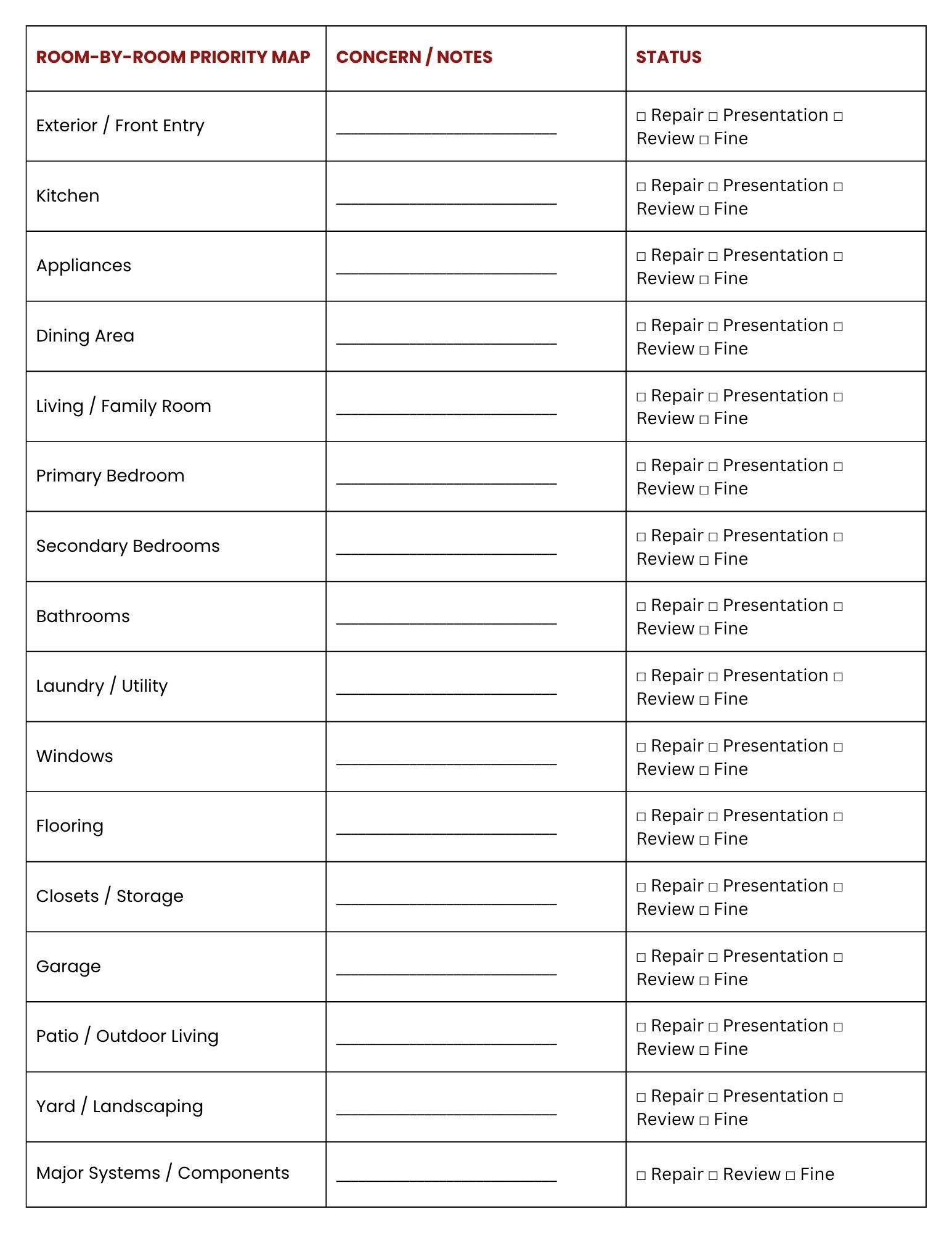
The kitchen may be perfectly acceptable while one appliance needs attention. The primary bedroom may need nothing more than decluttering. The flooring in one area may deserve a closer look while the rest of the home is fine.
Breaking the house into smaller areas makes it much easier to separate actual concerns from things that are simply older or personal preference.
Use this as a first pass through the property. The goal is not to decide what to spend yet. It is simply to identify which areas are fine as-is and which ones deserve a closer look.
Once you know what needs review, then you can start evaluating individual projects.
Decide What
Actually Deserves Money
This is where sellers can get into trouble.
A project may sound reasonable on its own. But one improvement often creates another.
You replace the countertops, and suddenly the backsplash looks dated. Then the cabinet hardware feels old. After that, the lighting no longer seems right.
What started as one update quietly becomes half a kitchen renovation.
Was the original problem really worth all of that?
Maybe.
But maybe not.
The same caution applies to appliances, flooring, bathrooms, paint, and other cosmetic improvements. An older but functioning appliance does not automatically need replacing. Clean flooring does not necessarily need to be removed because it is no longer the newest style. A bathroom does not need a remodel simply because it was installed ten years ago, and every wall does not need fresh paint simply because new paint would look nicer.
Would those changes improve the house?
Probably.
But the better question is:
Would they improve the sale enough to justify the cost?
If you spend $15,000 preparing the property and the home sells for only a few thousand dollars more than it otherwise would have, was that really the best use of the money?
And what if the buyer plans to change those finishes anyway?
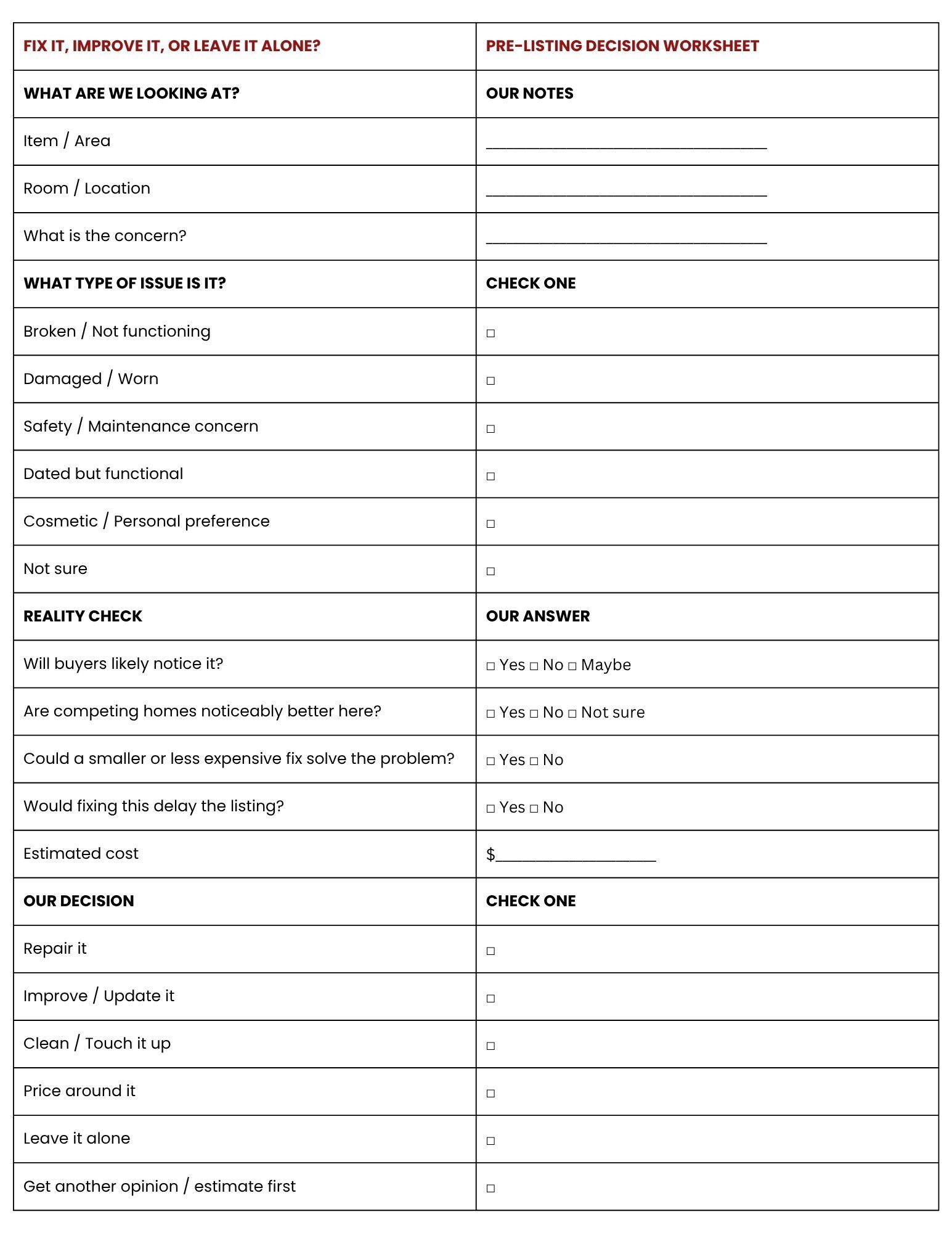
That is why I would rather evaluate each questionable item individually than work from a generic list of things sellers are “supposed” to update.
Use this worksheet for one repair, update, or questionable item at a time. Is it broken? Damaged? Dated but functional? Mostly cosmetic? Are competing homes noticeably better in this area? Could a smaller fix solve the same problem?
Sometimes the answer is repair it.
Sometimes it is improve it.
Sometimes it is clean it up.
And sometimes the answer is simply:
Leave it alone.
Presentation Can Matter More Than Renovation
Some of the highest-impact preparation is also the simplest. A deep clean, clearer countertops, touched-up paint, clean windows, trimmed landscaping, and fewer distractions can make a home feel much more cared for without turning it into a renovation project.
A home does not need to feel new. It needs to feel maintained.
The same goes for decluttering. Buyers should be able to understand the space without being distracted by packed counters, crowded closets, or oversized furniture.
The goal is not empty. The goal is clear.
Paint and flooring should solve an actual problem. Heavily scuffed walls or damaged flooring may deserve attention; clean, neutral walls and older but functional flooring may not.
Would replacing them make the home look better? Probably.
Would it improve the sale enough to justify the cost?
That is the better question.
Curb appeal works the same way. A tidy yard, clean walkway, trimmed landscaping, and cared-for entry can make a strong first impression without an expensive landscape project.
Staging should also have a purpose. Maybe a vacant room needs help showing scale, or an occupied home simply needs less furniture.
Before adding another expense, ask:
What exactly are we trying to improve?
Remember the Cost
Is More Than the Invoice
There is another cost sellers sometimes overlook when deciding whether to complete a project:
Time.
Suppose an improvement costs $10,000 and delays your listing by six weeks.
During those six weeks, you may continue carrying the property. Inventory could change. Buyer activity could shift. Interest rates could move. Your next move could be delayed.
That does not mean you should rush the home onto the market before it is ready.
It means a project does not only have a contractor’s price tag.
It may also have a timing cost.
And then there is the cumulative cost.
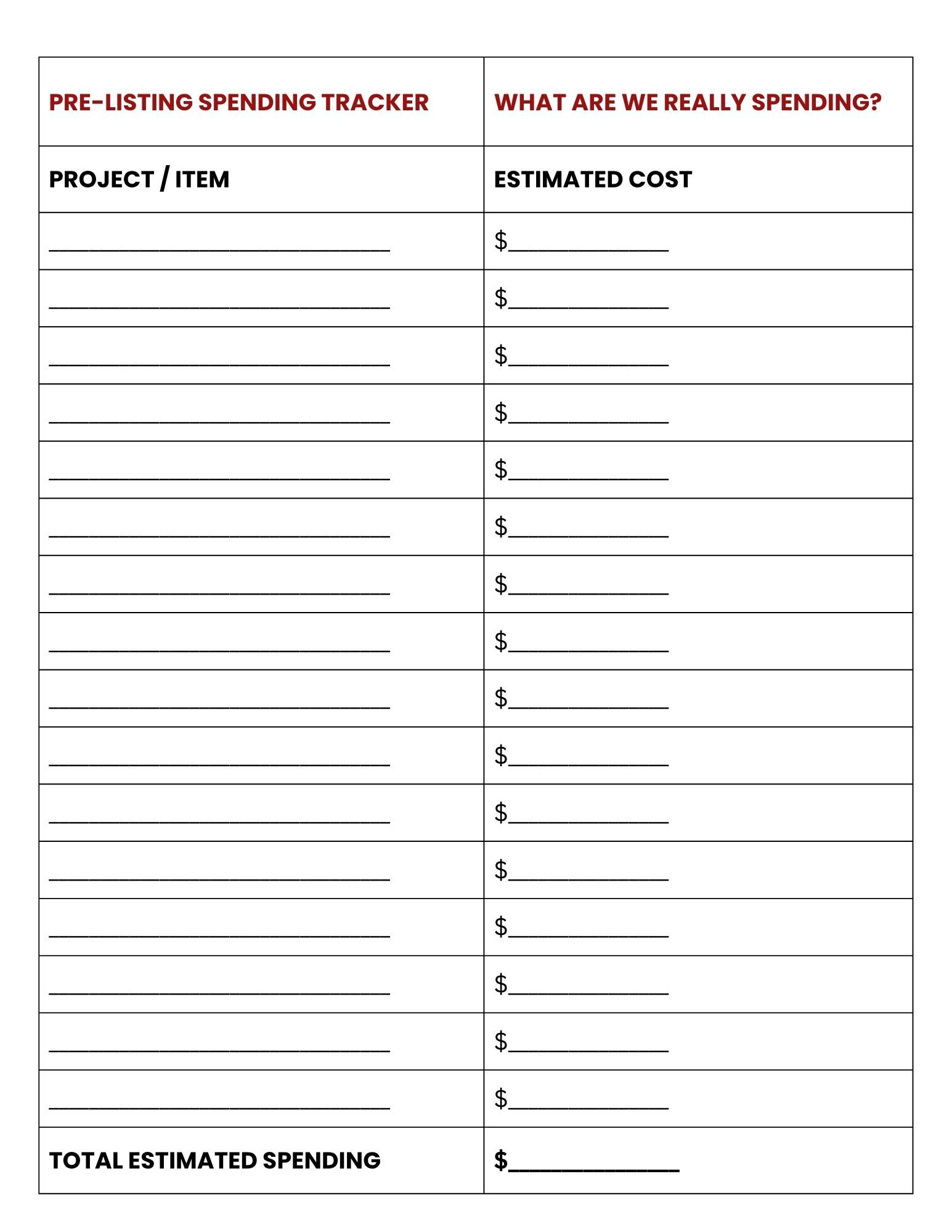
A $600 repair may sound reasonable. So might another $1,200 project, a $2,000 flooring repair, some landscaping, a little paint, and several smaller purchases.
But how do those decisions feel once the total reaches $8,000, $12,000, or more?
Sellers can approve projects one at a time without ever stopping to look at what they are spending as a whole.
Use the tracker to list every project you are considering and its estimated cost before committing to all of them.
Sometimes seeing the total changes which projects still feel worthwhile.
You Usually Have
More Than Two Choices
Sellers often assume the decision is:
Fix it or don’t fix it.
There may be more options than that.
Depending on the issue, you may be able to repair something, replace it, clean it, adjust the price, offer a credit in the right circumstances, disclose the condition and sell as-is, or simply wait to see whether the buyer even considers it a concern.
Not every issue has to be solved before the listing begins.
And not every future buyer objection needs to be anticipated.
Before spending money on a pre-listing project, I would ask a few basic questions: Is this broken or simply dated? Will buyers actually notice it? Are competing homes noticeably better in this area? Could a smaller fix solve the same problem? And will this improvement help the sale enough to justify both the cost and the time?
If you cannot clearly explain what the project is supposed to accomplish, that is usually a good reason to pause.
The Bottom Line
Preparing a home to sell does not mean making it perfect.
It means making thoughtful decisions about where your money and effort are most likely to matter.
Address obvious maintenance. Reduce unnecessary distractions. Make the property feel clean and cared for. Understand what buyers can choose instead. And be cautious about major cosmetic projects that may reflect your preferences more than the market’s expectations.
Sometimes the right answer is to repair something. Sometimes it is to clean it. Sometimes it is to update it. Sometimes it is to price around it.
And sometimes the smartest advice I can give a seller is:
“I would not spend the money.”
Next in the Seller’s Reality Check Series
👉 Pricing Without Chasing the Market (release date 10/9/2026)
(Start at the beginning: Selling a Home, Clearly | The Seller’s Reality Check Series
)
How do you choose a price that gives your home a strong position without starting so high that buyers begin comparing it with better alternatives?
That is what we will cover next.
Message Cindy to receive your complete copy of the Seller’s Reality Check Series and sell with clarity instead of guesswork.
📞
Call or Text:
(469) 499-7452
📧
Email:
cindycoggins@kw.com
⭐
See why so many clients trust us—check out our 5-star reviews on Google.
Disclaimer:
This series is provided for general educational purposes only and is not intended as legal, financial, tax, lending, inspection, insurance, appraisal, title, accounting, or real estate advice. Every seller’s situation is different, and market conditions, property condition, contract terms, financing, appraisal results, closing costs, tax consequences, timelines, and transaction decisions can vary. Readers should verify information independently and consult the appropriate professionals, including a real estate agent, lender, inspector, insurance provider, appraiser, title company, attorney, CPA, tax professional, and other qualified advisors as needed. Information is deemed reliable but not guaranteed.
Search Post
Recent Post










 Mr. Website Designer