
How to Protest Your Property Taxes in Collin County (Annual Homeowner Guide)
Deadlines, Steps, and What Homeowners Should Know Each Spring
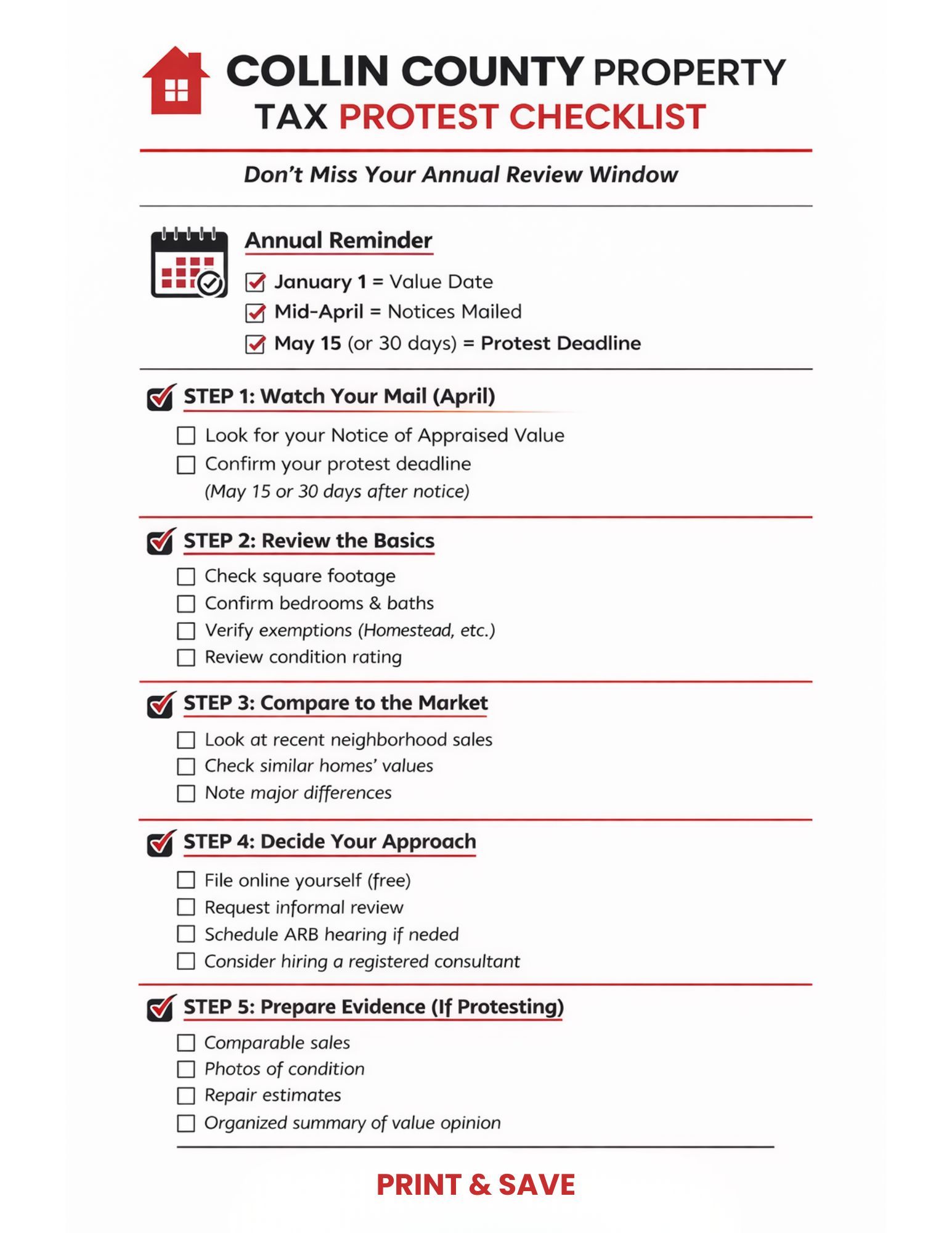
Every spring, Collin County homeowners receive a document that often causes confusion: your Notice of Appraised Value.
This is not your tax bill, it is not automatically wrong, and it is not something you are required to protest.
However, it is your annual opportunity to review how your property is being valued for tax purposes and decide whether the assessment appears accurate.
Here’s a simple breakdown of how the property tax protest process works in Collin County.
First: How Property Taxes Work
Your property taxes are based on a simple formula:
Appraised (taxable) value × tax rate = property taxes owed
Here’s how it works:
The Collin Central Appraisal District (CCAD) determines your property’s market value.
Local taxing entities—such as your city, county, and school district—set the tax rates.
CCAD does not set tax rates and does not collect property taxes.
Your appraisal reflects the district’s opinion of your property’s value as of
January 1 of that tax year.
Important Dates to Know
While mailing dates can vary slightly each year, these deadlines remain consistent:
January 1 – Your property’s condition and value are determined as of this date.³
Around April 15 – Appraisal notices are typically mailed.¹
May 15 or 30 days after your notice is mailed (whichever is later) – Protest deadline.² ¹
If you plan to protest, meeting the deadline is critical.
Most homeowners simply treat April and early May as their “Property Tax Review Season.”
Do You Have to Protest Every Year?
No.
But you should review your Notice of Appraised Value every year.
It’s especially important to take a closer look if:
Your
property value increased significantly from last year
Your home has
deferred maintenance or needed repairs
Similar nearby homes appear to be
valued lower
Your
exemptions are missing or recorded incorrectly
In some cases, everything will look accurate. In others, you may find discrepancies worth addressing. Either way, the review gives you clarity and confidence in how your property is being assessed.
Free vs. Paid Protest Options
1. DIY Protest (Free)
Homeowners can file a protest online through CCAD at no cost.¹
This process typically includes filing the protest, submitting supporting evidence, participating in an informal review, and attending an Appraisal Review Board (ARB) hearing if needed.
The primary investment here is your time and preparation.
2. Hiring a Property Tax Consultant
Some homeowners choose to hire a property tax consultant, who typically charges a percentage of the first-year tax savings.
If someone is representing you for compensation, Texas law requires proper registration as a property tax consultant.⁵ These professionals are regulated through the Texas Department of Licensing and Regulation (TDLR).⁶
Informal Review vs. Formal Protest
Informal Review
You can submit information directly to an appraiser for reconsideration. However, this does not automatically preserve your protest rights—you must still file a formal protest by the deadline if you want to keep that option available.¹
Formal ARB Protest
A formal protest is heard before the Appraisal Review Board (ARB).²
You may participate in several ways:
- In person
- By affidavit
- By phone or video (a written request is generally required at least 10 days before the hearing)⁴
How to Strengthen Your Case
If you choose to protest, preparation matters.
Step 1: Verify Property Details
Before arguing value, confirm the basics of your property record, including square footage, number of bedrooms and bathrooms, any improvements, current condition, and applicable exemptions.
Factual errors in these areas can affect your case.²
Step 2: Gather Strong Evidence
Comparable Sales
Look for recently sold homes in the same neighborhood with similar size, age, and condition.
Condition Documentation
Photos, contractor estimates, or repair quotes can help support claims about needed improvements or deferred maintenance.
Uniformity (Equity) Argument
You may also compare your home to similar nearby properties that have lower appraised values.²
Step 3: Keep It Organized
A strong protest packet is typically clear and focused. It may include a short summary of your opinion of value, three to six relevant comparable properties, and any supporting photos or repair documentation.
Clear, concise evidence is often more effective than overwhelming detail.
The Bigger Picture—
And Where a Real Estate Agent Can Help
Property values change over time, and market conditions continue to evolve.
Each year presents an opportunity to review your appraised value in the context of what’s happening locally. Think of it as a routine financial check-in—a simple way to stay informed about how your property is being assessed.
If you’d like additional perspective, our agents can provide:
Recent comparable sales
Insight into neighborhood pricing trends
Context around how your appraisal compares to current market activity
Whether you’re planning to stay in your home or considering a future move, having clear information can help you make more confident decisions.
For a straightforward snapshot of recent neighborhood sales, contact us anytime—we’re happy to share the data.
📞 Call or Text: (469) 499-7452
📧 Email:
cindycoggins@kw.com
⭐ See why so many clients trust us—check out our 5-star reviews on Google.
Disclaimer
This article is provided for general informational purposes only and is not intended as legal, tax, or financial advice. Property tax laws, deadlines, and procedures may change, and individual circumstances vary. Homeowners should verify all information directly with the Collin Central Appraisal District or consult with a qualified tax professional or attorney regarding their specific situation.
Sources:
[1] Collin Central Appraisal District (CCAD).
Appraisal and Protest Process; Online Protest Portal; Appraisal Cycle Information.
www.collincad.org
[2] Texas Comptroller of Public Accounts.
Property Tax Basics; Property Tax Protests; Taxpayer Rights and Remedies.
www.comptroller.texas.gov
[3] Texas Comptroller of Public Accounts.
Property Taxpayer Remedies (Publication 96-1425).
www.comptroller.texas.gov
[4] Collin County Appraisal Review Board (ARB).
Formal Hearing Procedures and Participation Guidelines.
www.collinarb.org
[5] Texas Legislature.
Texas Occupations Code, Chapter 1152 — Property Tax Consultants.
statutes.capitol.texas.gov
[6] Texas Department of Licensing & Regulation (TDLR).
Property Tax Consultant Registration Requirements.
www.tdlr.texas.gov
Search Post
Recent Post











 Mr. Website Designer