
Pricing Without Chasing the Market
How to Choose a Smart Starting Price Without Reacting Too Late

Pricing is one of the hardest decisions sellers make because you have to choose a number before the home has given you any direct market feedback.
We can study recent sales, current competition, pending activity, condition, location, upgrades, inventory, and buyer behavior. We can make a well-supported decision.
But until the home is actually for sale, we do not know exactly how buyers will respond.
That uncertainty can make a higher starting price feel safer.
Why not try the higher number first? If buyers do not respond, can't we just come down later?
You can.
But I want sellers to understand what that decision actually changes.
Your asking price affects more than how much you are requesting for the home. It influences which buyers see it, which homes they compare it with, and what they expect your home to offer when they walk through the door.
So instead of asking:
“What is the highest price we can justify?”
I would ask:
“Where does this home have the strongest position in the market we are entering?”
Price Is a Position,
Not Just a Number
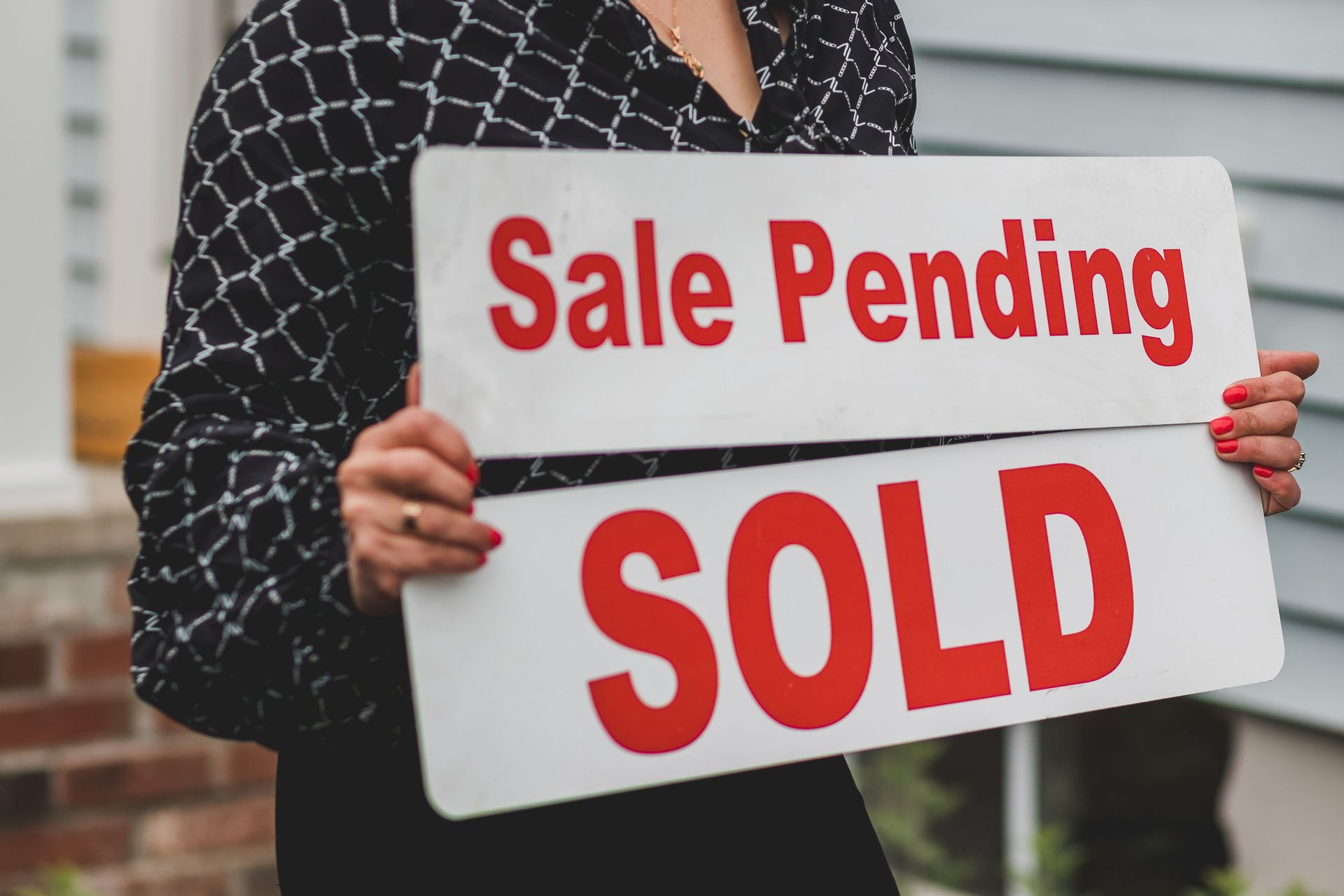
Recent sales matter because they show what buyers have actually been willing to pay.
But those homes are only part of the picture.
A buyer shopping today cannot purchase the house that closed three months ago. They are also looking at the homes currently available, and they are paying attention to the properties that appear to be going pending.
Suppose a similar home recently sold for $600,000.
That sounds encouraging.
But what if buyers can currently choose among several comparable homes priced between $565,000 and $585,000?
That $600,000 sale still matters. But now we need to understand why that home sold for more and whether your property gives today’s buyer enough reason to make the same decision.
That is why I look at sold, pending, and active properties differently.
Sold homes tell us what happened.
Active homes show us what buyers can choose today.
Pending activity can help show us which choices buyers are making now, even though we generally do not know the final sales price until the transaction closes.
None of those categories tells the whole story by itself.
The goal of this tool is not to find the highest comparable.
It is to answer a more useful question:
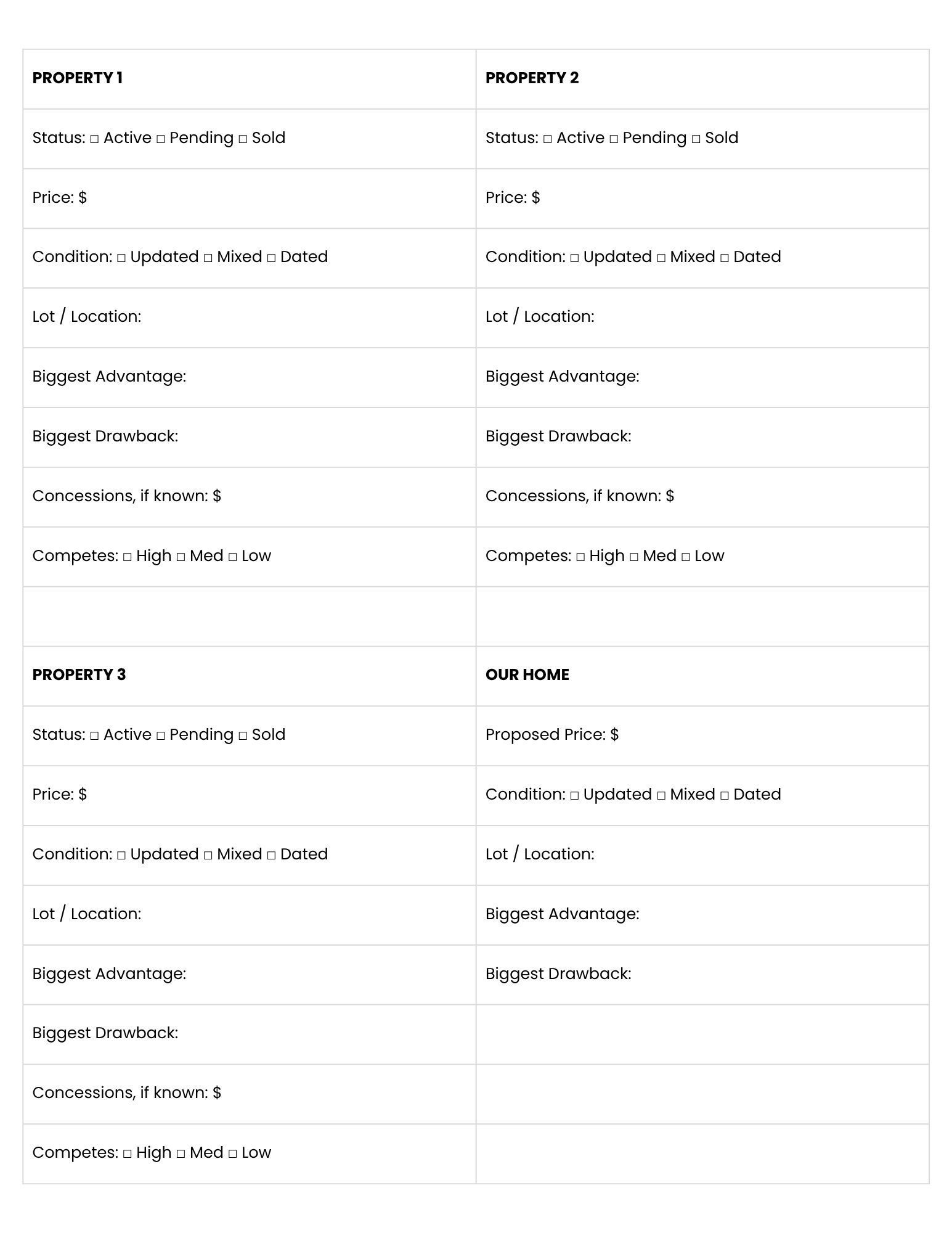
At our proposed price, what homes will buyers compare us with most closely?
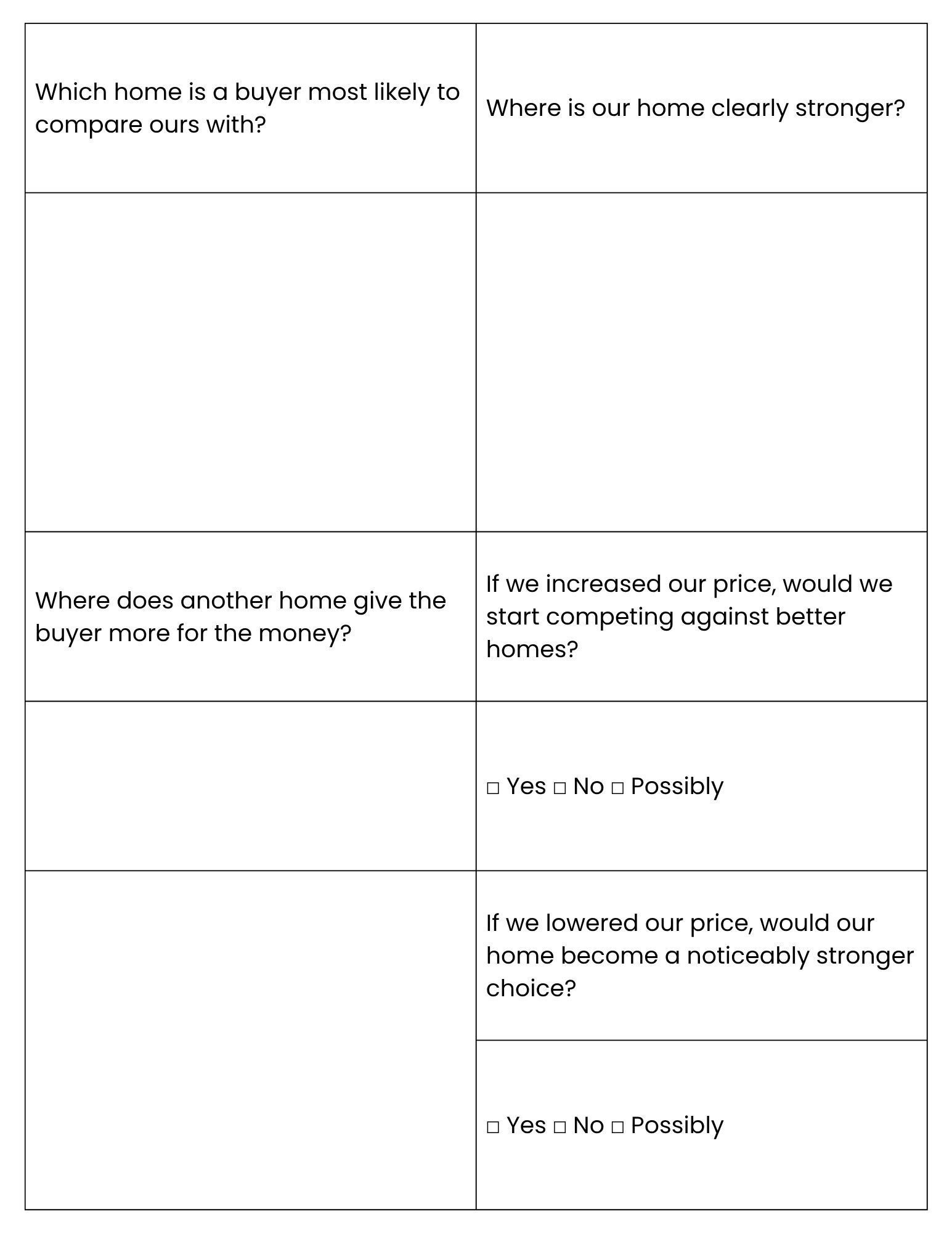
Comparable
Does Not Mean Identical
Two houses can be the same size, in the same neighborhood, and still not be equally valuable to a buyer.
One may have a premium lot. Another may back to a busy road. One may have a pool, newer major systems, a three-car garage, extensive updates, or a more functional floor plan.
That is why I would be cautious about grabbing the highest sale in the neighborhood and saying:
“They got $625,000, so ours should too.”
Maybe.
But why did they get $625,000?
That is the useful question.
The same caution applies to price per square foot. It can help us recognize patterns, but it should not become a shortcut for value.
Buyers do not purchase square footage in a vacuum.
There is another detail worth checking when possible: seller concessions.
Two homes may both show a $600,000 sales price, but if one seller contributed significantly toward the buyer’s closing costs or other negotiated expenses and the other did not, those were not necessarily identical transactions.
The headline price matters.
It is not always the whole story.
Pricing Is Usually a Range Before It Is a List Price
Sellers often expect pricing to produce one exact number.
Sometimes the evidence does not work that way.
A comparative market analysis may support a reasonable range rather than one magical price.
Suppose the evidence suggests buyers may see the home somewhere between $590,000 and $610,000.
That does not mean the pricing analysis failed.
It means there is a strategy decision to make within that range.
Would $599,000 position the home more strongly against the current competition? Would $610,000 put it against noticeably better properties? Is inventory increasing or shrinking? Are the most relevant homes sitting, reducing, or going pending?
There may also be more uncertainty when very few truly comparable homes have sold.
I would rather acknowledge that uncertainty than pretend the house is worth exactly $603,742.
The market ultimately determines what a buyer is willing to pay.
Our job before listing is to choose the starting point that gives the home a strong opportunity to compete.
Your Price Changes Who You Compete Against
This is one of the most overlooked parts of pricing.
Suppose the evidence suggests your home is competitive around $600,000, but you decide to start at $635,000 because you want room to negotiate.
The risk is not simply that buyers may think $635,000 is too much.
You may have changed the homes they use to judge yours.
At $600,000, your property may compare favorably with other homes around $600,000.
At $635,000, buyers may now be seeing newer kitchens, better lots, pools, larger garages, more upgrades, or fewer condition concerns.
Now the question is no longer:
“Is this a good $600,000 house?”
It becomes:
“Is this as good as the other homes I can buy for around $635,000?”
That can be a much harder comparison to win.
A higher list price does not just ask buyers for more money.
It may raise the standard they expect your home to meet.
Decide Before Listing What Would Make You Reconsider the Strategy
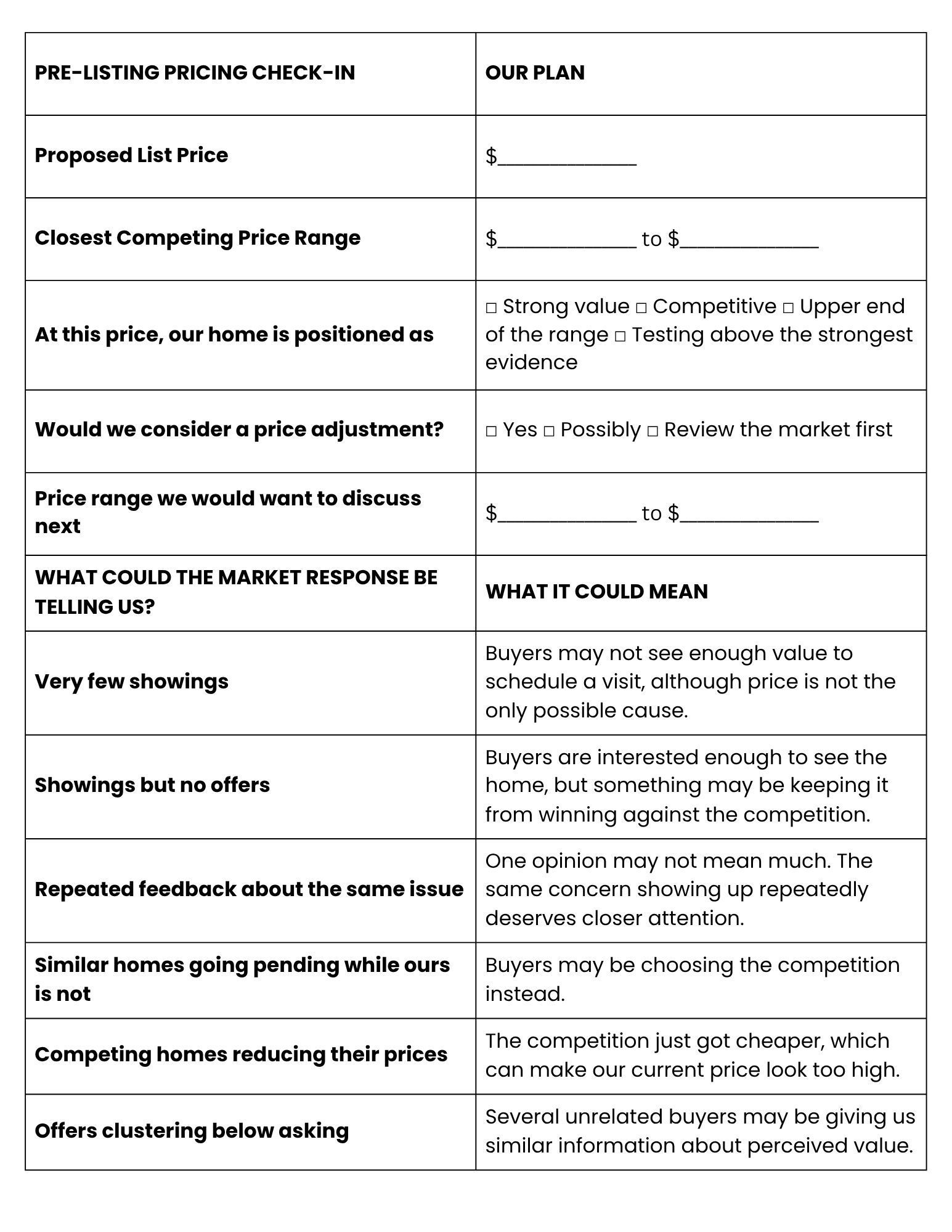
This is one of the most useful conversations to have before a home goes active. Pricing can become emotional once the listing is live, especially when a few quiet days start to feel much longer because it is your house. At the same time, sellers can sometimes overlook several weeks of consistent evidence because everyone is still attached to the number they started with.
I do not want to panic because a few days have passed, but I also do not want to ignore a pattern simply because we liked the original price. Before listing, I would rather agree on what we are actually going to watch. That might include showing activity, repeated buyer feedback, competing homes reducing their prices, similar properties going pending while ours does not, or buyers consistently reacting to the same issue.
The goal is not to predict exactly what will happen. It is to decide in advance what information we are willing to pay attention to if the market responds differently than expected.
Testing the market is still a pricing strategy.
But the market is also testing the listing.
The Bottom Line
Pricing is not about being optimistic or pessimistic.
It is about position.
A higher price may sound like it protects the seller, but it can also place the home against stronger competition, exclude some buyers, and create expectations the property then has to meet.
Starting thoughtfully does not mean we will never change the price.
It means we know why we chose it.
And if the market gives us new information, we do not have to react out of frustration or defend the original number simply because it was ours.
We can look at the evidence and adjust intelligently.
Price with a plan. Then let the market tell you whether the plan is working.
Next in the Seller’s Reality Check Series
👉
Going Live: What Happens After Your Home Hits the Market (10/12/2026)
👈 Previously:
Preparing Your Home Without Overspending
(Start at the beginning:
Selling a Home, Clearly | The Seller’s Reality Check Series
)
The photography is finished. The listing is active. Buyers can finally see it.
Now the market starts giving us information we did not have before.
In the next article, we will look at what online activity, showing patterns, buyer feedback, competing listings, and the first days on market can actually tell you—and what they cannot.
Message Cindy to receive your complete copy of the Seller’s Reality Check Series and sell with clarity instead of guesswork.
📞
Call or Text:
(469) 499-7452
📧
Email:
cindycoggins@kw.com
⭐
See why so many clients trust us—check out our 5-star reviews on Google.
Disclaimer:
This series is provided for general educational purposes only and is not intended as legal, financial, tax, lending, inspection, insurance, appraisal, title, accounting, or real estate advice. Every seller’s situation is different, and market conditions, property condition, contract terms, financing, appraisal results, closing costs, tax consequences, timelines, and transaction decisions can vary. Readers should verify information independently and consult the appropriate professionals, including a real estate agent, lender, inspector, insurance provider, appraiser, title company, attorney, CPA, tax professional, and other qualified advisors as needed. Information is deemed reliable but not guaranteed.
Search Post
Recent Post









 Mr. Website Designer