
Closing Week Without the Panic | The Buyer’s Reality Check Series
Closing Phase

By closing week, the major decisions are already behind you—but this is often when anxiety resurfaces. Documents move quickly, timelines tighten, and ownership begins to feel real.
That stress does not necessarily mean something is wrong.
It often means the process is nearing its conclusion.
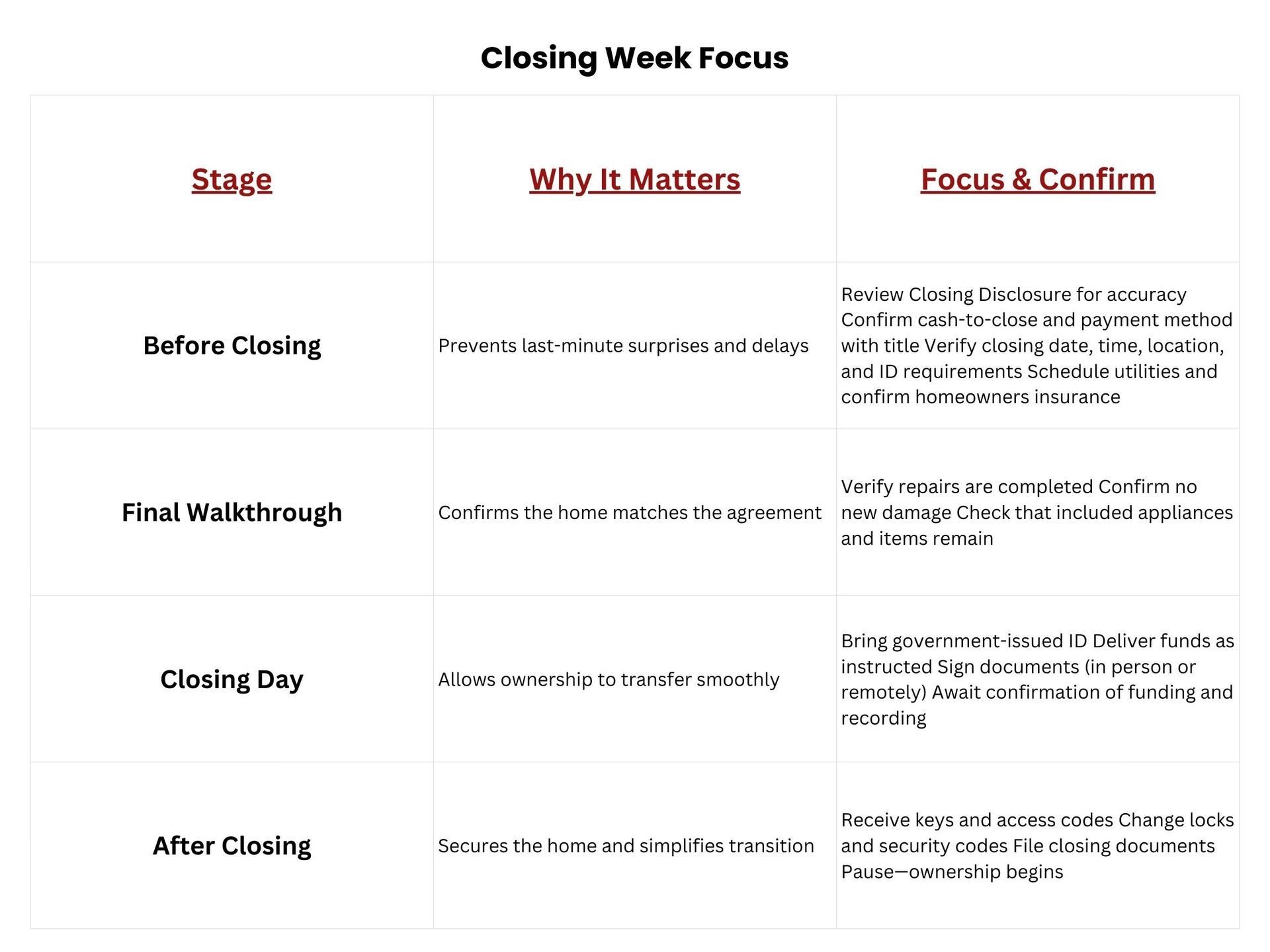
Closing week is largely administrative. Financing is nearing completion, title work is being finalized, and the remaining steps are focused on confirmation rather than major new decisions. Feeling overwhelmed usually comes from a large amount of information arriving at once—not from a problem with the transaction itself.
Much of the work happens quietly behind the scenes as lenders, title companies, and other professionals finalize the details needed for closing. That silence can feel uneasy, but it often signals that the transaction is progressing. The final walkthrough serves a specific purpose: confirming that the home is in the agreed-upon condition before ownership transfers.
Closing day itself is typically more straightforward than buyers expect. Documents are signed, funds are delivered according to closing instructions, and ownership transfers once the transaction funds and records appropriately. The anticipation often feels heavier than the moment itself.
Closing week works best when buyers slow down, take each task one step at a time, and rely on structure instead of adrenaline.
More Moving & Transition Tools on Pinterest
Closing week is only one part of the transition. Moving, settling in, and adjusting to a new routine all come with their own questions—and those details look different for every household.
That’s why we’ve curated a dedicated collection of practical, real-life tools to help buyers personalize their move beyond the transaction itself.
Click the links to find easy-to-use guides and checklists for topics like moving with pets, address changes, and packing.
Frequently Asked Questions About Closing Week
When should buyers confirm their closing appointment?
Buyers should confirm the date, time, location, and signing requirements as soon as the title company provides final scheduling details. If more than one buyer is signing, each person should confirm whether they need to attend in person or sign separately.
What should buyers bring to closing?
Buyers are usually asked to bring a valid photo ID and any required funds or proof of wire transfer. Because requirements can vary, buyers should confirm directly with the title company before closing day.
How can buyers protect themselves from wire fraud?
Buyers should verify wiring instructions directly with the title company using a trusted phone number before sending money. They should not rely only on emailed instructions, links, or last-minute message changes.
Why do closing costs sometimes change before closing?
Closing costs may adjust because of taxes, prepaid interest, insurance, HOA fees, lender updates, credits, or title-related items. Buyers should review the final numbers carefully and ask questions about anything unfamiliar.
What happens if a buyer cannot attend closing in person?
In some situations, a buyer may be able to sign remotely, use a mobile notary, or arrange a power of attorney. These options should be discussed early with the lender, title company, and appropriate professionals because approval and timing requirements can vary.
Should utilities be scheduled before or after closing?
Buyers often begin setting up utilities before closing, but service start dates should match the expected possession timeline. This helps avoid gaps in service while still respecting the contract and closing schedule.
What should buyers check before moving in?
Before moving in, buyers should confirm access details such as keys, garage remotes, gate codes, mailbox information, alarm instructions, trash pickup, HOA contacts, and utility setup. These small items can make the first few days of ownership much smoother.
When should buyers update their mailing address?
Buyers should update their address around the time of closing and move-in. Common places to update include the post office, bank accounts, employer records, insurance policies, subscriptions, voter registration, driver’s license records, and important service providers.
Continue the Buyer Journey
Previously:
👉Appraisals, Underwriting & the Waiting Game
Next:
The transaction may be complete, but homeownership is just beginning. The final post focuses on the first 90 days after closing—what to document, what to prioritize, and how to settle in with greater confidence.
Making Informed Buying Decisions Across North Texas & DFW
If you are planning to buy a home in Van Alstyne, Melissa, Allen, or anywhere across North Texas and the DFW Area, Cindy Coggins Realty Group can help you evaluate your options, understand how local market conditions may affect your decisions, and move forward with greater clarity at every stage of the process.
When you are ready, reach out to start the conversation and move forward with confidence.
Message Cindy to receive your complete copy of the Buyer’s Reality Check Series and buy with clarity instead of guesswork.
📞
Call or Text:
(469) 499-7452
📧
Email:
cindycoggins@kw.com
⭐
See why so many clients trust us—check out our 5-star reviews on Google.
Disclaimer:
This series is provided for general educational purposes only and is not intended as legal, financial, tax, lending, inspection, insurance, or real estate advice. Every buyer’s situation is different, and market conditions, loan requirements, contract terms, property conditions, timelines, and transaction decisions can vary. Readers should verify information independently and consult the appropriate professionals, including a real estate agent, lender, inspector, insurance provider, title company, attorney, CPA, and other qualified advisors as needed. Information is deemed reliable but not guaranteed.
Search Post
Recent Post











 Mr. Website Designer