
Evaluating an Offer Beyond the Price
What Makes an Offer Stronger Than the Number at the Top

An offer comes in, and naturally the first thing most sellers look at is the price.
That number matters.
But it does not tell you what you will actually receive, how many things still have to go right before closing, or whether the terms work with what you are trying to accomplish.
A $600,000 offer is not automatically stronger than a $595,000 offer. The higher offer may ask for seller concessions, carry more appraisal risk, depend on another transaction, or create timing problems. The lower offer may—or may not—give the seller a cleaner path to closing.
So instead of asking only:
“How much are they offering?”
I want to ask:
“What does this entire offer actually look like for the seller?”
That is the shift that matters.
Start With What the
Offer Is Actually Worth
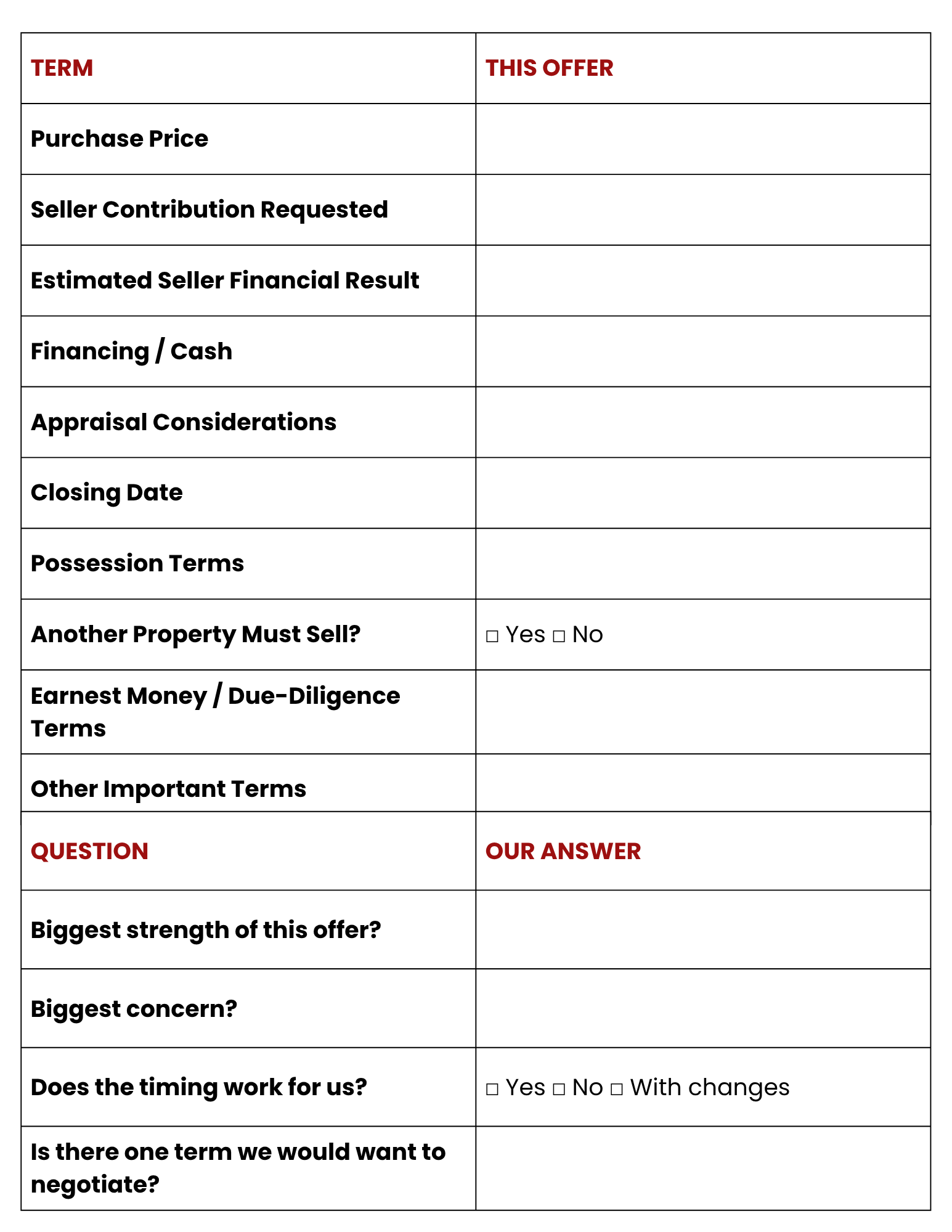
Purchase price is the headline number. It is not necessarily the seller's result.
Suppose a buyer offers $600,000 but asks the seller to contribute $12,000 toward allowable buyer costs. Another buyer offers $594,000 without that request.
At first glance, the first buyer offered $6,000 more.
That does not mean the seller is $6,000 better off.
And seller contributions are only one piece. Depending on the offer, other terms may affect what the seller ultimately receives or pays.
This is where I want to get away from the emotional reaction to the offer price and bring the conversation back to the seller's actual goal.
Before listing, we estimated what a sale might look like.
Now we have real terms in front of us.
What is this offer likely to mean financially—not just what number is written on the first page?
Then Look at What Has
to Happen Before Closing
Two offers with similar financial results can still carry very different paths to closing.
A financed buyer may need lender approval and an appraisal. Another buyer may be further along in underwriting. A cash buyer may remove financing from the equation but still have other terms that deserve careful review.
I would not automatically rank offers by labels like cash, conventional, FHA, or VA and assume one tells us everything we need to know.
I want to understand the actual buyer behind the offer.
How prepared are they? What still has to happen? Are the funds or financing reasonably documented? Is another transaction involved? Are there dependencies outside this contract that could affect this one?
A contingency is a good example.
A buyer who needs to sell another property before purchasing yours introduces another moving part. But even that does not tell us enough by itself. There is a substantial difference between a buyer whose home has not been listed and one whose home is already under contract and well into that transaction.
The question is not:
“Does this offer have risk?”
Every transaction has some.
The better question is:
“What still has to happen between acceptance and closing, and how comfortable are we with that path?”
A Higher Price Can Come With More Appraisal Exposure
This becomes especially important when an offer pushes above the price the market appears to support.
An above-asking offer feels good.
But the buyer and the appraiser are answering two different questions.
The buyer is deciding what they are willing to pay.
The appraiser, when one is required, is developing an opinion of value for the lender.
Those numbers do not automatically have to match.
So if one offer is substantially higher than the others, I do not only want to celebrate the difference. I want to understand what happens if the appraisal does not support it.
Has the buyer offered any protection against an appraisal shortfall? How much? What happens under the actual contract if the value comes in lower?
A $610,000 offer that becomes a major negotiation later may not ultimately be stronger than a $600,000 offer with less appraisal exposure.
That does not mean we should be afraid of a high offer.
It means:
The number matters only if we understand what supports it.
Timing Is Part
of the Value Too
This is an area where the best offer can be very different from seller to seller.
If you are moving into an empty house and want to close quickly, one timeline may be ideal.
If you need the proceeds from this sale to purchase the next home, that changes the calculation.
If your new construction home will not be ready for another month, an extremely fast closing could actually create a problem unless possession or temporary housing is addressed.
That is why I do not consider the closing date an administrative detail at the bottom of the offer.
It can affect the seller's next purchase, moving costs, temporary housing, storage, possession, and overall stress of the move.
Sometimes a few thousand dollars more makes those complications worthwhile.
Sometimes it does not.
The strongest offer should work with the seller's real life, not just produce the highest number on paper.
Look at What the
Buyer Is Asking for in Return
A strong purchase price can become less impressive as additional requests are added.
That does not make those requests unreasonable. Buyers may need assistance with allowable closing costs. They may request particular items or terms. They may want a certain amount of time for due diligence.
Those are normal parts of negotiation.
But they are still part of the offer.
The mistake is mentally separating the attractive price from everything the buyer is asking the seller to give back.
If a buyer offers more but asks for more, we need to evaluate the combination.
The same applies to the buyer's contractual protections. Earnest money, termination provisions, due-diligence periods, financing terms, and other provisions should be read together rather than treated as independent trophies.
A large earnest-money amount, for example, does not mean the buyer has surrendered whatever termination rights the contract gives them.
One impressive term does not erase the rest of the contract.
When There Is More Than One Offer, Make the Differences Visible
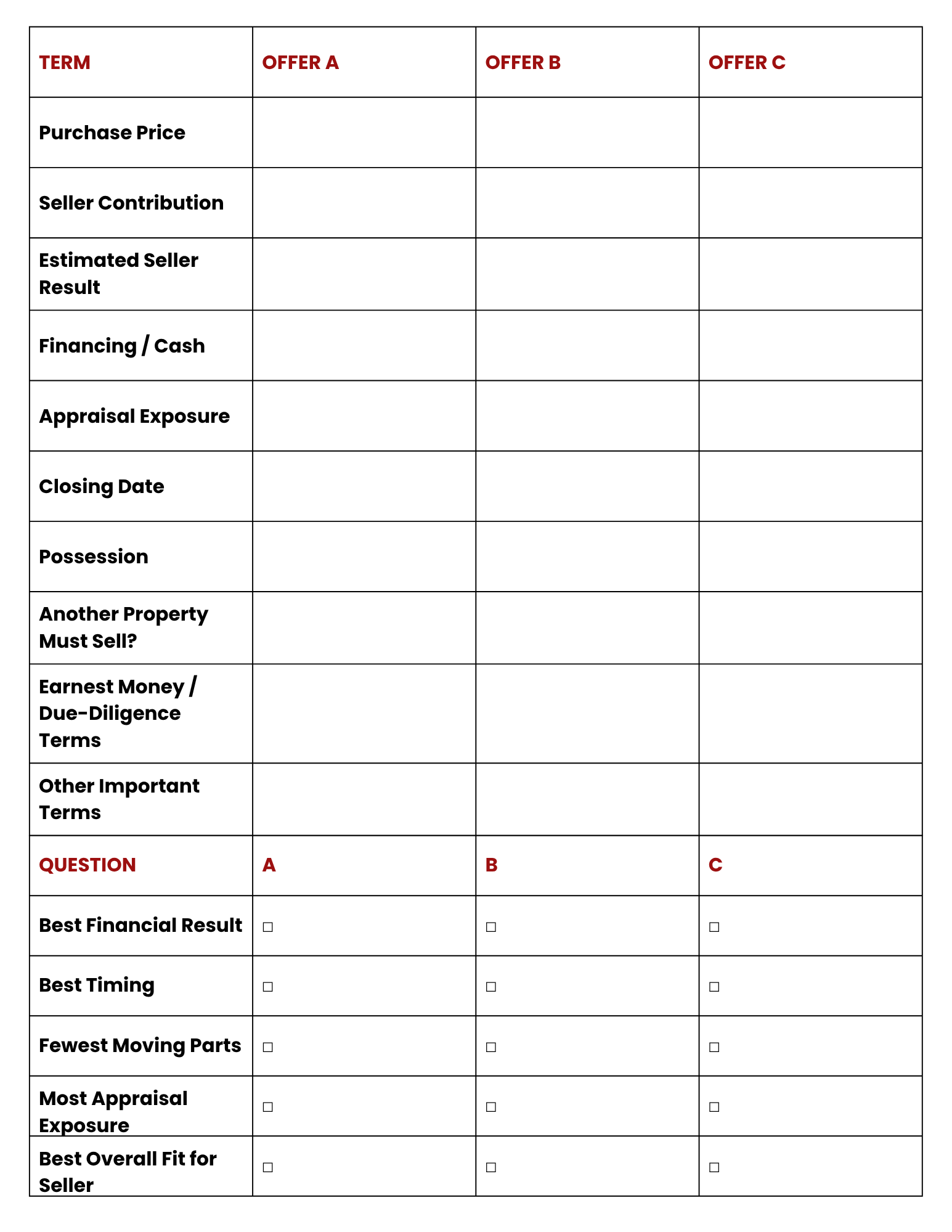
Multiple offers can make this harder because the numbers start blending together.
One has the highest price. Another asks for fewer concessions. Another has a better closing date. One appears financially stronger but includes a term that matters to the seller.
Trying to hold all of that in your head is how an important detail gets missed.
This is when I want the offers compared in the same format so we can see what is actually different.
Not to turn the decision into a mathematical score.
There may be one term that matters enormously to this particular seller and barely matters to another.
The purpose is simply to stop one exciting number from overshadowing the rest of the deal.
Negotiate the Part That Actually Needs Negotiating
An offer does not always require an all-or-nothing decision.
Sometimes most of the offer works.
Maybe the price is acceptable, but the concession request is too high. Maybe the closing date creates a problem. Maybe the seller can agree to the timing but needs a different possession arrangement.
That gives us something specific to solve.
I do not believe in countering an offer simply because sellers feel they are supposed to negotiate.
If the offer already accomplishes what you need and the terms make sense, unnecessary negotiating can introduce unnecessary risk.
But I also would not accept a term that clearly creates a problem simply because we are afraid the buyer might walk away.
The better question is:
“What would need to change for this offer to work for us?”
Now the negotiation has a purpose.
The Bottom Line
The highest offer may absolutely be the best offer.
It just should not win automatically.
The real comparison is between what the seller is likely to receive, what still has to happen before closing, how much uncertainty comes with the terms, and whether the timing actually works.
A good offer is not simply a high number.
It is a deal the seller understands and is comfortable moving forward with.
Do not just compare the prices. Compare the deals.
Next in the Seller's Reality Check Series:
👉 Inspections, Repairs & the Second Negotiation (release date 10/15/26)
👈Previously: When the House Is Not Selling
Start at the beginning:
Selling a Home, Clearly | The Seller’s Reality Check Series
Once the contract is signed, the negotiation may not be finished.
Inspections can introduce information neither side had when the offer was written, and that can lead to new decisions about repairs, credits, price, or whether something actually needs to be addressed at all.
That is what we will cover next.
Message Cindy to receive your complete copy of the Seller’s Reality Check Series and sell with clarity instead of guesswork.
📞
Call or Text:
(469) 499-7452
📧
Email:
cindycoggins@kw.com
⭐
See why so many clients trust us—check out our 5-star reviews on Google.
Disclaimer:
This series is provided for general educational purposes only and is not intended as legal, financial, tax, lending, inspection, insurance, appraisal, title, accounting, or real estate advice. Every seller’s situation is different, and market conditions, property condition, contract terms, financing, appraisal results, closing costs, tax consequences, timelines, and transaction decisions can vary. Readers should verify information independently and consult the appropriate professionals, including a real estate agent, lender, inspector, insurance provider, appraiser, title company, attorney, CPA, tax professional, and other qualified advisors as needed. Information is deemed reliable but not guaranteed.
Search Post
Recent Post











 Mr. Website Designer