
When the House Is Not Selling
How to Figure Out
What the Market Is Actually Telling You

At some point, a listing moves beyond the normal uncertainty of the first few days.
The home has had exposure. Buyers have had a chance to see it. Some may have scheduled showings. Others may have looked online and moved on. Competing homes may have gone pending or changed price.
That is when the question changes.
It is no longer simply:
“Do we need more time?”
It becomes:
“What is keeping buyers from moving forward?”
That distinction matters because a home can struggle for very different reasons. Some buyers may never schedule a showing. Others may come through and decide another home offers more. A few may return, ask questions, and still stop short of making an offer.
Those are different problems.
And they should not automatically get the same solution.
The goal now is to stop guessing and start diagnosing.
Start With Where
Buyers Are Stopping
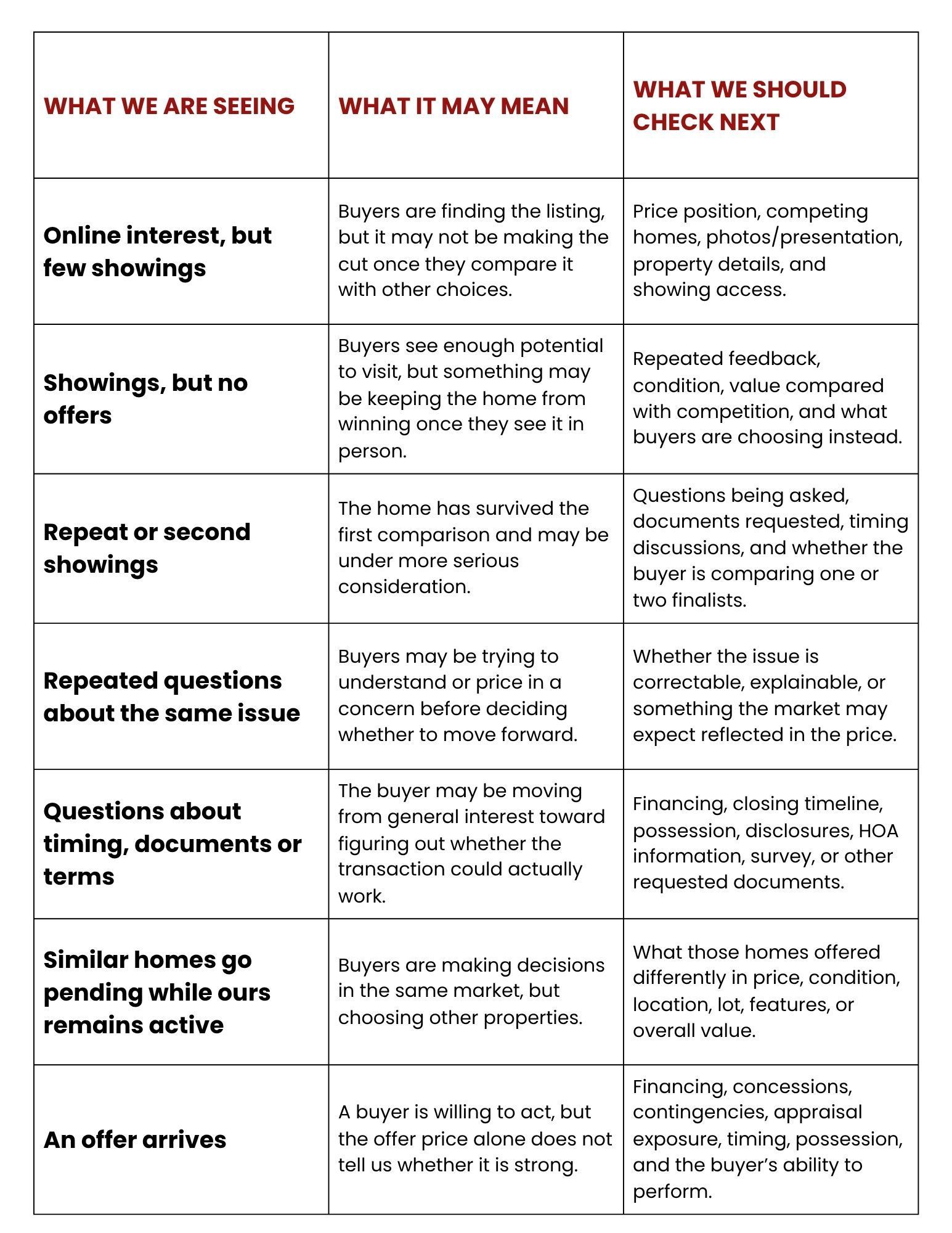
One of the most useful things we can look at is where interest seems to break down.
If buyers are seeing the listing but not scheduling showings, the issue may be happening before they ever walk through the door. Price, location, property features, presentation, or simply a smaller buyer pool may all be part of that.
If buyers are coming through the home but not making offers, the property is clearing the first hurdle. Something else is keeping it from becoming their first choice.
And if buyers are returning for second showings, bringing another decision-maker, or asking more detailed questions, we know the home is getting further into the decision process.
That does not guarantee an offer.
But it gives us better information.
Where buyers stop can help tell us where to look next.
Feedback Is More Useful When It Matches Behavior
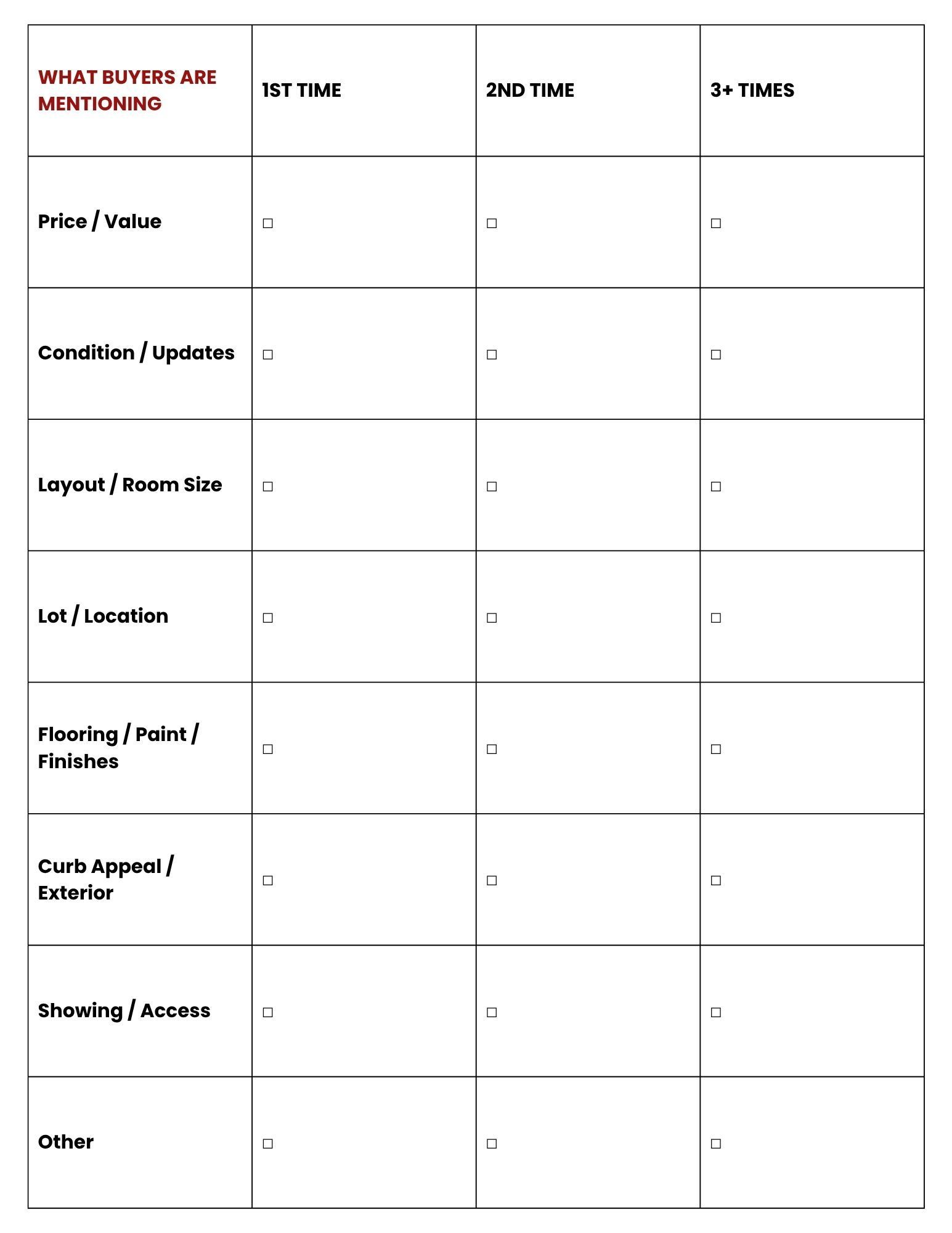
Seller feedback can be useful, but one comment by itself usually does not tell us much.
One buyer may think the kitchen feels dated. Another may like it.
One may dislike the backyard. Another may see it as low maintenance.
The real value comes when the same issue starts showing up repeatedly and buyer behavior supports it.
If several unrelated buyers mention the same concern and then choose other homes that solve that concern, we have something worth paying attention to.
That still does not automatically mean we should fix it.
Some issues are not worth spending money on. Some cannot be changed at all. Others may simply need to be accounted for in the way the home is positioned.
That is why I am less interested in collecting comments than I am in understanding what those comments may be telling us about the buyer’s decision.
One comment is an opinion. A repeated pattern supported by buyer behavior is information.
Look at What Buyers
Are Choosing Instead
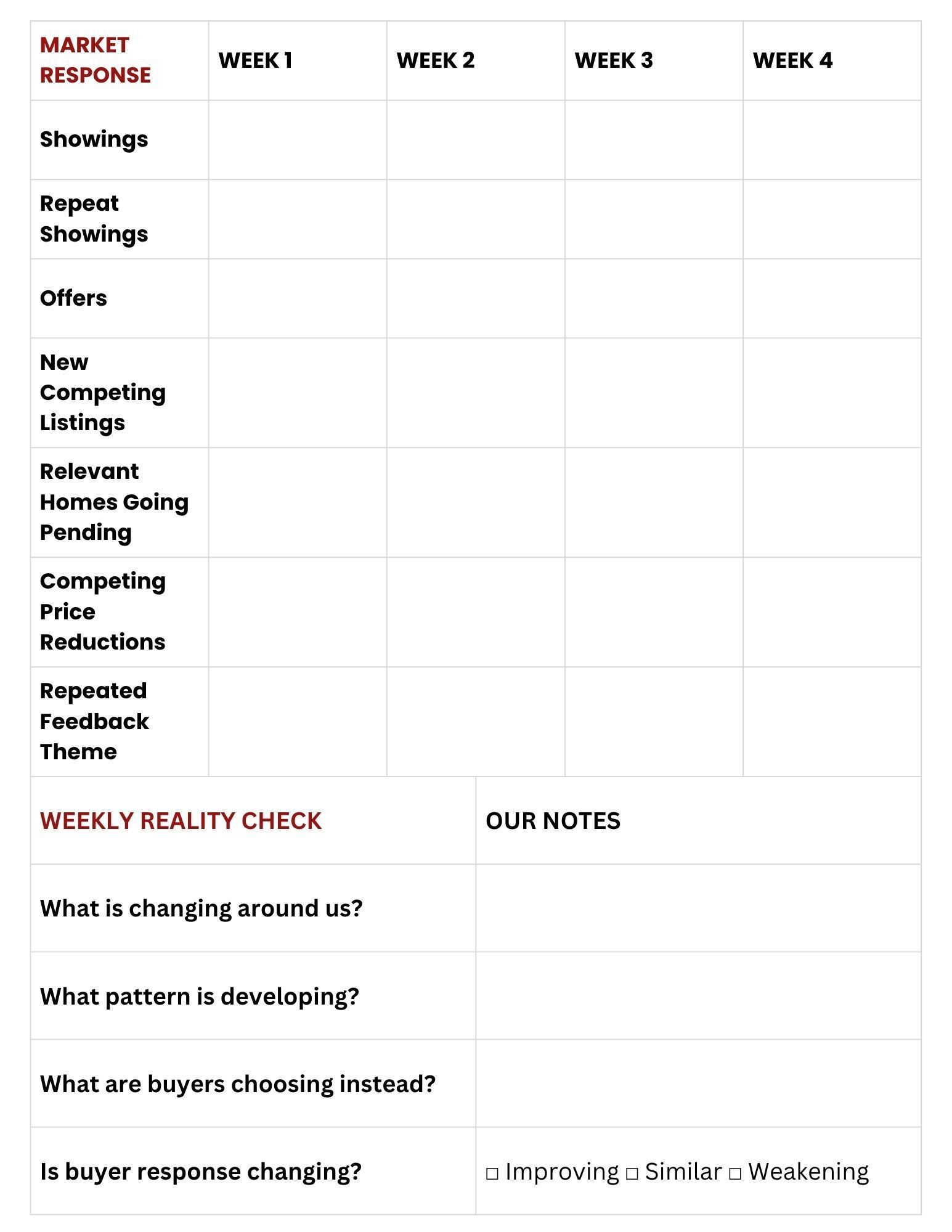
This is often where the picture becomes clearer.
Buyers are not evaluating your home in isolation.
They are comparing it with whatever else they can buy in the same general price range, location, and property type.
That means I want to know what the alternatives look like now—not what they looked like when we first listed.
Maybe a more updated home has come on the market.
Maybe another seller reduced their price.
Maybe one of the strongest competing homes went pending.
Maybe several comparable homes are sitting just as long as ours.
All of that matters.
If everything around us is moving slowly, the issue may be broader than this one property.
If similar homes are going pending while ours remains active, then we need to understand why buyers are choosing those homes instead.
That is much more useful than simply staring at the days-on-market number.
Sometimes the Problem
Is Value, Not Just Price
When a home is not selling, price is usually one of the first things everyone wants to talk about.
Sometimes that is appropriate.
But the better question is not:
“Can we justify this price?”
It is:
“Does the home feel competitive at this price compared with what buyers can choose today?”
A seller may be able to point to comparable sales that support the asking price. But buyers are not standing in the kitchen with a CMA. They are comparing the home with whatever else they can buy right now.
That is why an objection is not always something that needs to be fixed.
A buyer may accept dated flooring at one price but reject it at another. They may live with a smaller backyard if the overall value feels strong enough. They may overlook a busy road, an unusual floor plan, or an older kitchen if the rest of the offering makes sense.
Some of those things can be changed.
Some cannot.
And even when something can be changed, that does not automatically mean it should be.
Once the home is already active, a project costs more than the invoice. It also costs time, creates disruption, and may add more days on market without actually changing the buyer’s decision.
So before spending money, I would ask:
Will this change the buyer’s decision—or just make the house nicer?
If the answer is unclear, the better move may be to leave the home as it is and adjust the way it is positioned instead.
A house does not have to be perfect to sell.
But buyers do need to feel that the price makes sense for the compromises they are being asked to accept.
Know When to Change Something—and When to Leave It Alone
Once a listing feels slow, there is a natural urge to do something.
That is understandable.
But action is only useful when it addresses the actual problem.
If buyers are having trouble getting in, the issue may be access. If the same condition concern keeps coming up, we need to decide whether fixing it is worth the cost. If buyers consistently choose better-positioned homes, then the conversation may need to come back to value.
What I would not do is change the price, rewrite the remarks, replace photos, add incentives, move furniture, and schedule another open house all at once simply because everyone is getting uncomfortable.
That creates motion.
It does not necessarily create progress.
The same is true with waiting.
Some homes naturally take longer. A unique property or higher price range may have a smaller buyer pool, and if the competition is moving at a similar pace, patience may still make sense.
But patience should not become an excuse to ignore a pattern.
If the same objections keep repeating, stronger competitors are selling, and the home continues losing the same comparison, more time may not solve anything.
So the question is not:
“How many days has it been?”
It is:
“Has the market given us enough consistent information to justify a change?”
Sometimes the answer is:
“Not yet.”
Sometimes it is:
“Yes. We know enough now.”
That is the difference between reacting and making a strategic decision.
The Bottom Line
When a house is not selling, the answer is not automatically to lower the price—or simply wait longer.
Sometimes the right move is patience. Sometimes the evidence points to a change.
Diagnose first. Change second.
Next in the Seller’s Reality Check Series:
👉 Evaluating an Offer Beyond the Price (release date: 10/14/2026)
👈
Previously:
Going Live: What Happens After Your Home Hits the Market
Start at the beginning:
Selling a Home, Clearly | The Seller’s Reality Check Series
When an offer arrives, the price is only part of the story.
Financing, concessions, contingencies, appraisal risk, timing, possession, and the buyer’s ability to perform can all affect how strong that offer really is.
That is what we will cover next.
Message Cindy to receive your complete copy of the Seller’s Reality Check Series and sell with clarity instead of guesswork.
📞
Call or Text:
(469) 499-7452
📧
Email:
cindycoggins@kw.com
⭐
See why so many clients trust us—check out our 5-star reviews on Google.
Disclaimer:
This series is provided for general educational purposes only and is not intended as legal, financial, tax, lending, inspection, insurance, appraisal, title, accounting, or real estate advice. Every seller’s situation is different, and market conditions, property condition, contract terms, financing, appraisal results, closing costs, tax consequences, timelines, and transaction decisions can vary. Readers should verify information independently and consult the appropriate professionals, including a real estate agent, lender, inspector, insurance provider, appraiser, title company, attorney, CPA, tax professional, and other qualified advisors as needed. Information is deemed reliable but not guaranteed.
Search Post
Recent Post











 Mr. Website Designer