
Going Live: What Happens After Your Home Hits the Market
What the First Days
and Weeks Can Actually Tell You

The listing is live. The photos are up, the description is finished, and buyers can finally see the home.
And then sellers start watching everything.
How many people viewed it? Why has no one scheduled a showing yet? Three buyers came through—why didn't anyone make an offer? What did they say? Should we change something?
Those are reasonable questions. But this is where I would be careful about giving too much meaning to too little information.
One quiet day is not a market verdict. Neither is one showing, one comment, or one buyer who decides the home is not for them.
Once the home goes active, we finally start receiving information we did not have before. The goal is not to react to every piece of it.
The goal is to recognize when individual activity starts becoming a pattern.
The First Few Days
Are Information, Not a Verdict
There is a lot of pressure placed on the first weekend.
Sometimes a well-positioned home in an active price range receives significant attention almost immediately. Other homes take longer, and that does not automatically mean something is wrong.
Price range matters. Location matters. Property type matters. A home that appeals to a broad group of buyers may move differently from a unique property with a much smaller buyer pool. Holidays, weather, interest rates, new competition, and even showing availability can affect early activity.
So I would not look at one slow afternoon and say:
“We have a problem.”
But I also would not want to explain away weeks of weak activity with:
“We just need the right buyer.”
There is a reasonable time for patience. There is also a point when the market's response deserves a closer look.
What Buyer Activity
Is Actually Telling Us
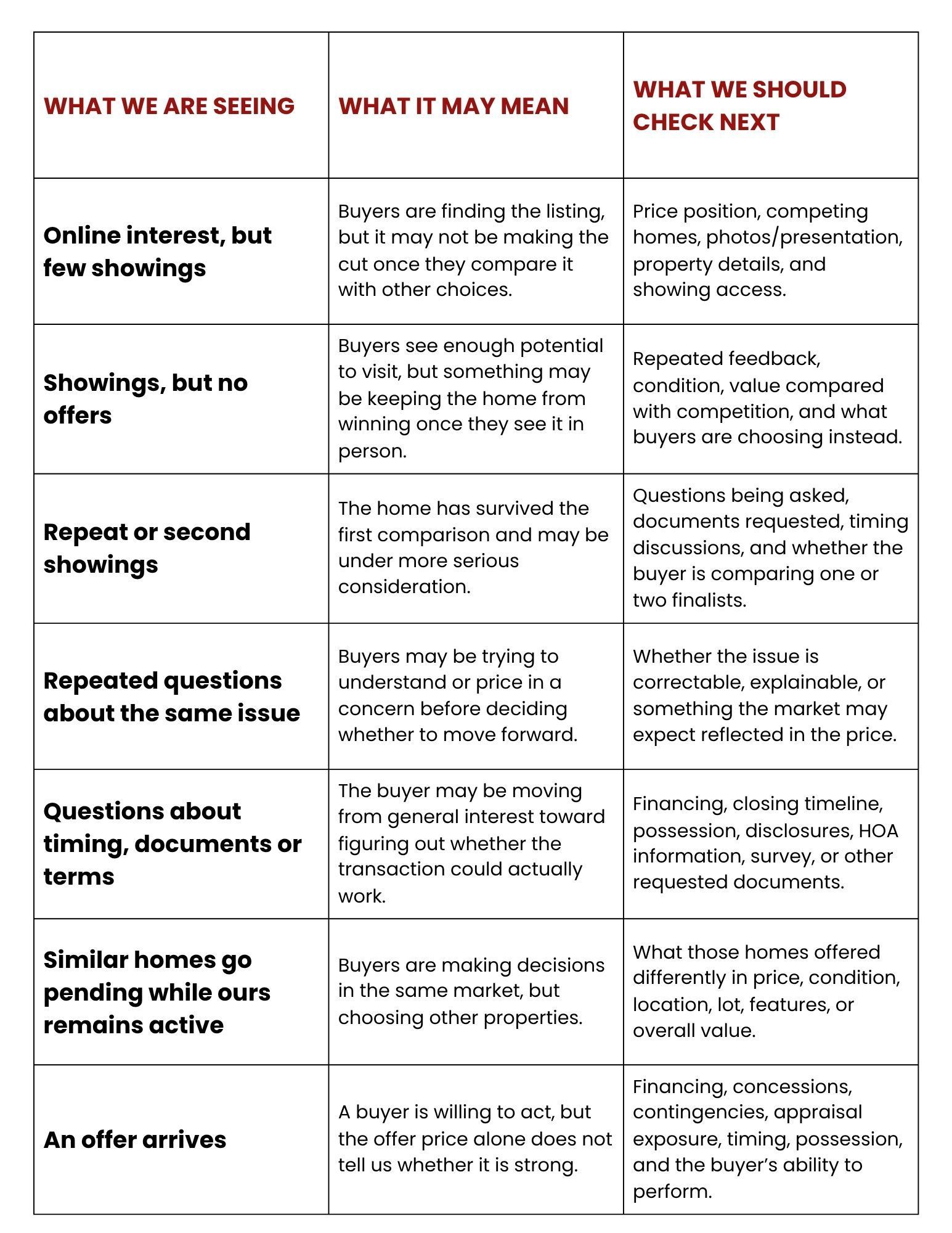
Not all activity means the same thing.
Online views and saves can tell us that buyers are noticing the property, but they require very little commitment. Someone may click because they like the neighborhood, are comparing prices, or simply want to see the photos.
A showing is different. That buyer has decided the home is worth putting on their schedule.
So if a listing gets plenty of online attention but very few showings, I would want to know why buyers are stopping before the next step. Is the asking price hard to justify against the competition? Is something in the photos, property details, location, or presentation narrowing the buyer pool? Are showing restrictions making the home harder to see?
Now suppose buyers are coming through the door, but no one is making an offer.
That tells us something different.
The home is making the first cut, but it may be losing the comparison once buyers see it in person. Maybe the condition feels different than expected. Maybe another home offers more for the money. Maybe an objection becomes much more important once buyers are standing in the property.
That is why I would not diagnose every quiet listing the same way.
Where buyers stop in the process can help tell us where to look.
Very few showings may point us toward the way the home is positioned before buyers ever walk inside. Plenty of showings with no offers may tell us the issue becomes clearer after they see it. Repeat showings suggest the home has survived the first comparison and is receiving more serious consideration.
A second showing, a buyer returning with a family member, asking for documents, discussing timing, or spending noticeably more time in the home does not guarantee an offer.
But it usually tells us something important:
The buyer has moved from “Should I see this?” to “Could this actually work for me?”
That is a much more useful distinction than simply counting activity.
Watch for
Patterns, Not Opinions
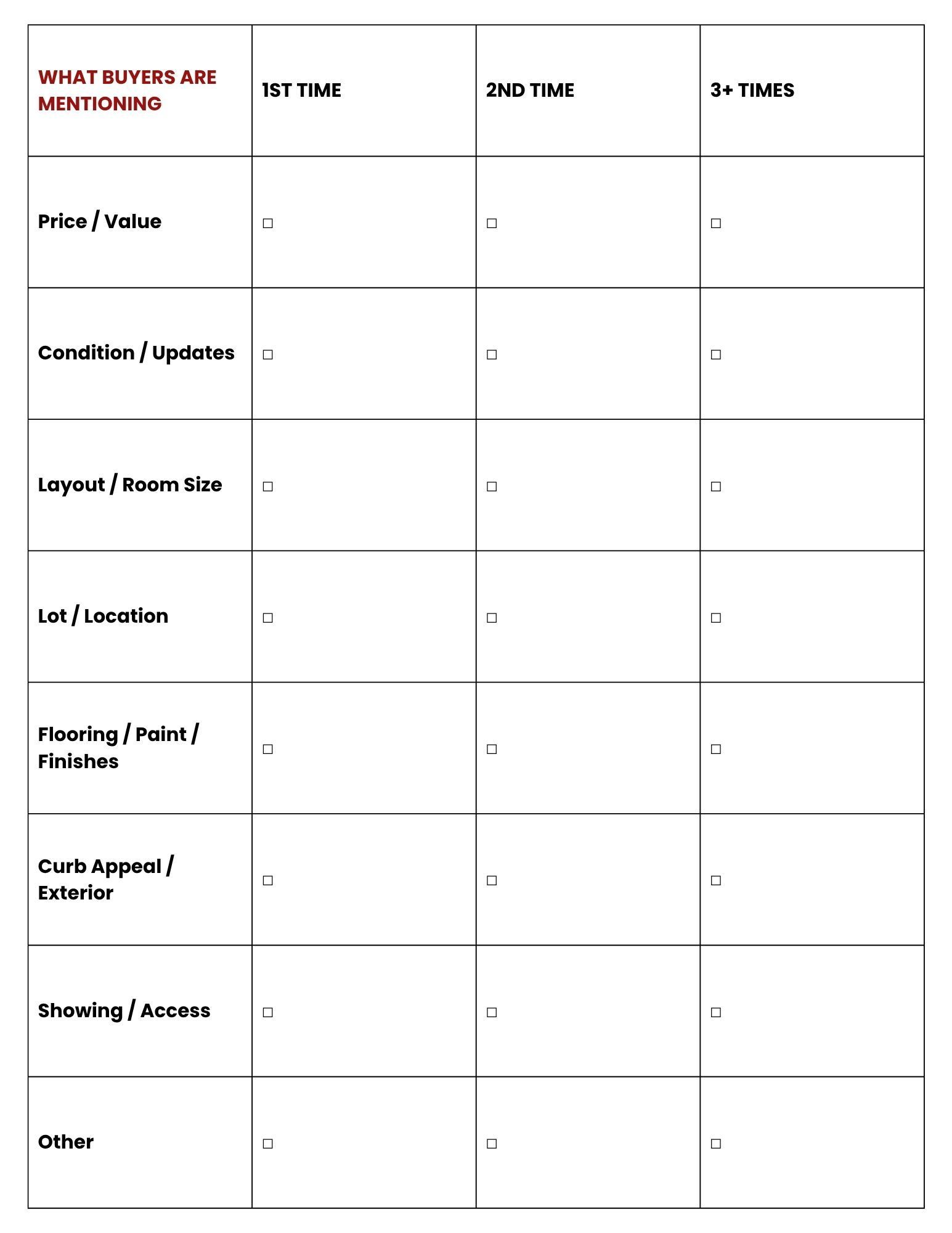
Buyer feedback can be helpful.
It can also make sellers crazy.
One buyer dislikes the flooring. Another likes it. Someone thinks the yard is too small. Another buyer thinks it is perfect. One person says the kitchen needs updating, while the next says they would not change a thing.
We cannot renovate the listing after every showing.
I care much more about repetition.
If one buyer says the bedrooms feel small, that may simply be that buyer.
If several unrelated buyers make the same observation, now we have information worth considering.
Even then, the answer is not automatically to “fix” whatever they mentioned. Some things cannot be changed. Others may not be worth changing.
But recurring feedback can help explain why buyers are behaving the way they are.
And sometimes their behavior tells us more than their comments.
A buyer may leave polite feedback saying:
“Beautiful home, just not the right fit.”
Fine.
But what did they choose instead?
Did they purchase something more updated? Something less expensive? A different lot? A different layout?
That is often the more useful question.
One buyer's comment is an opinion. Repeated feedback supported by buyer behavior is information.
The Competition
Does Not Stand Still
Your home does not stay in the same competitive position simply because your listing has not changed.
New homes come on the market. Some reduce their prices. Others go pending. A property that looked well positioned when you listed can face a very different set of choices a week or two later.
Suppose your home is listed at $600,000 and initially has two reasonable competitors. Then a more updated home enters the market at $585,000.
Your house did not suddenly become worse.
But the buyer now has another option.
The same is true when a similar home goes pending. We may not know the final sales price or all of the contract terms yet, but we do know a buyer looked at the available choices and decided to move forward with that property.
If several similar homes are going pending while ours remains active, I would want to understand what buyers are responding to. Is it price, condition, location, features, or simply easier access?
That last one matters more than sellers sometimes realize.
You still have to live in the home, and reasonable notice is completely understandable. But if a buyer can see four competing properties today and yours is unavailable until three days from now, they may make a decision before they ever walk through your door.
So I would keep asking two questions:
Where does our home fit among the choices buyers have today?
Do Not Change
Everything at Once
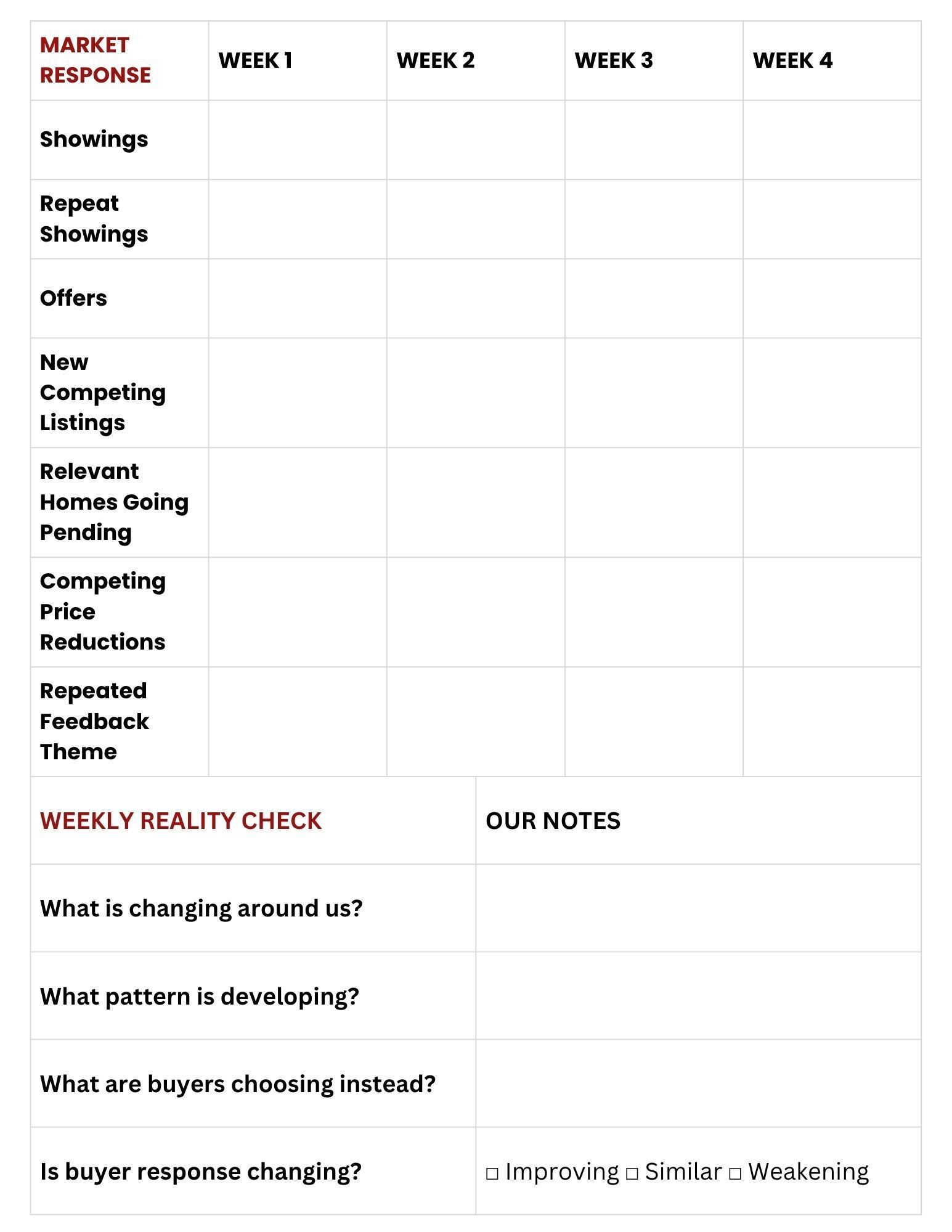
When a listing starts slowly, the temptation is to do something—anything. Change the price, replace the photos, rewrite the description, move furniture, loosen the showing instructions, add an incentive.
Sometimes more than one thing really does need attention. But if we change everything at once, we may solve the wrong problem—or never know what actually made the difference.
I would rather slow down and ask:
What does the evidence suggest is keeping buyers from taking the next step?
Before going live, we were asking, “Where should we position the home?” Once buyers can see it, the question becomes, “Is the market responding the way we expected?”
And if enough time and enough evidence eventually tell us the answer is no, the question changes again:
“What actually needs to change?”
Maybe price is part of it. Maybe it is condition, presentation, access, competition, or something about the property we cannot realistically change. And sometimes the answer is simply that the home needs more time.
The goal is not to make changes just so it feels like we are doing something.
It is to identify the most likely problem, make a deliberate adjustment, and then watch what happens next.
The important part is diagnosing the problem before prescribing the solution.
The Bottom Line
Going live is not the end of the strategy.
It is when the strategy begins getting tested by real buyers.
Some feedback will matter. Some will not. A quiet day is not a crisis, and one buyer's opinion should not send everyone scrambling.
But repeated behavior deserves attention.
My job is not to make every slow weekend sound alarming.
It is also not to keep telling a seller to wait when the evidence has started pointing consistently in another direction.
You start with a plan. Then you pay attention.
Next in the Seller's Reality Check Series:
👉 When the House Is Not Selling (release date: 10/13/2026)
👈
Previously:
Pricing Without Chasing the Market
Start at the beginning: Selling a Home, Clearly | The Seller’s Reality Check Series
At some point, a listing can move beyond normal early-market uncertainty.
Then the question becomes harder.
Is it price? Condition? Presentation? Competition? Showing access? Or something about the property that simply narrows the buyer pool?
And more importantly, what change would actually improve the situation instead of simply making us feel like we did something?
That is what we will cover next.
Message Cindy to receive your complete copy of the Seller’s Reality Check Series and sell with clarity instead of guesswork.
📞
Call or Text:
(469) 499-7452
??
Email:
cindycoggins@kw.com
⭐
See why so many clients trust us—check out our 5-star reviews on Google.
Disclaimer:
This series is provided for general educational purposes only and is not intended as legal, financial, tax, lending, inspection, insurance, appraisal, title, accounting, or real estate advice. Every seller’s situation is different, and market conditions, property condition, contract terms, financing, appraisal results, closing costs, tax consequences, timelines, and transaction decisions can vary. Readers should verify information independently and consult the appropriate professionals, including a real estate agent, lender, inspector, insurance provider, appraiser, title company, attorney, CPA, tax professional, and other qualified advisors as needed. Information is deemed reliable but not guaranteed.
Search Post
Recent Post











 Mr. Website Designer