
House Hunting Without Burnout | The Buyer’s Reality Check Series
Search Phase

House hunting can become exhausting after only a few showings. The overwhelm, confusion, and second-guessing many buyers feel are not personal failures—they are signs of decision fatigue. Every home requires dozens of small judgments, and without a clear framework, emotion begins to fill the gaps. Buyers may attach too quickly to one option or disengage entirely from the process.
Burnout is not always caused by seeing too many homes. More often, it comes from searching without a filter. Defining non-negotiables and flex areas before touring changes the central question from “Do we like it?” to “Does this fit?” That shift creates a more consistent way to compare homes and keeps individual showings from blurring together.
Pacing matters too. Touring too many homes without time to process can create confusion rather than clarity. When back-to-back showings are necessary, structure becomes even more important. Brief reset moments, clear notes, and intentional comparison help buyers stay grounded instead of reacting to whichever home they saw most recently.
Priorities may evolve during the search, and that is not a problem. The goal is not rigidity. It is awareness. Buyers who recognize when their preferences are changing can adjust thoughtfully instead of making reactive decisions under pressure.
When structure guides the process, stress tends to ease. The right home becomes easier to recognize—not because it is perfect, but because it aligns with the priorities, budget, and lifestyle the buyer defined before emotion took over.
How to Stay Grounded During the Search
1. Revisit your Decision Matrix before each round of showings
From:
Before You Ever Tour a Home
Review your non-negotiables and flex areas before emotion enters the process. This helps you tour with a clearer standard for what actually fits.
2. Use the House Hunt Tracker immediately after each tour
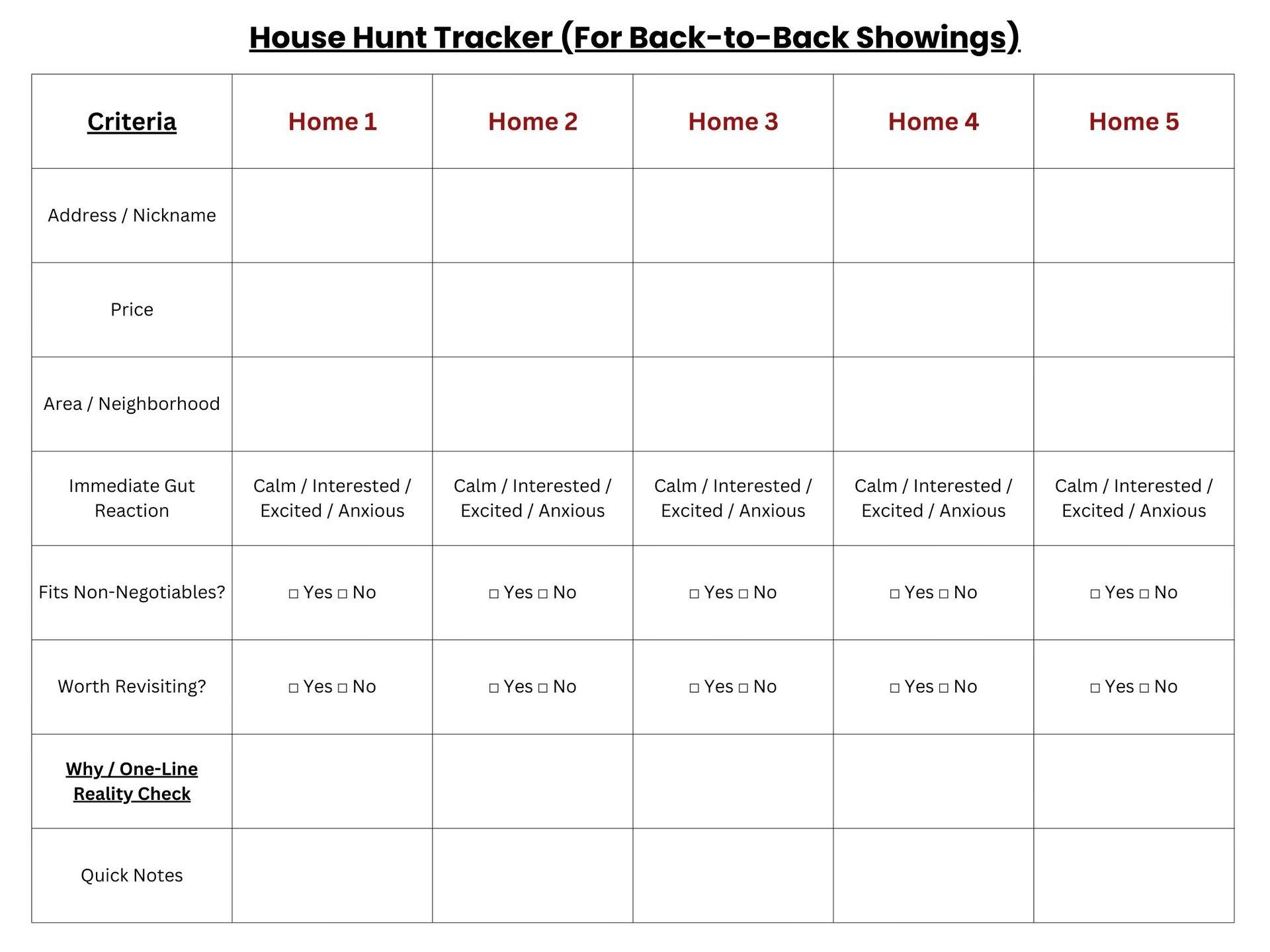
Tool #1: House Hunt Tracker—For Back-to-Back Showings
Capture first impressions, standout features, concerns, and overall fit while the home is still fresh in your mind. This keeps multiple properties from blending together.
3. Use the Home Comparison Snapshot only for serious contenders
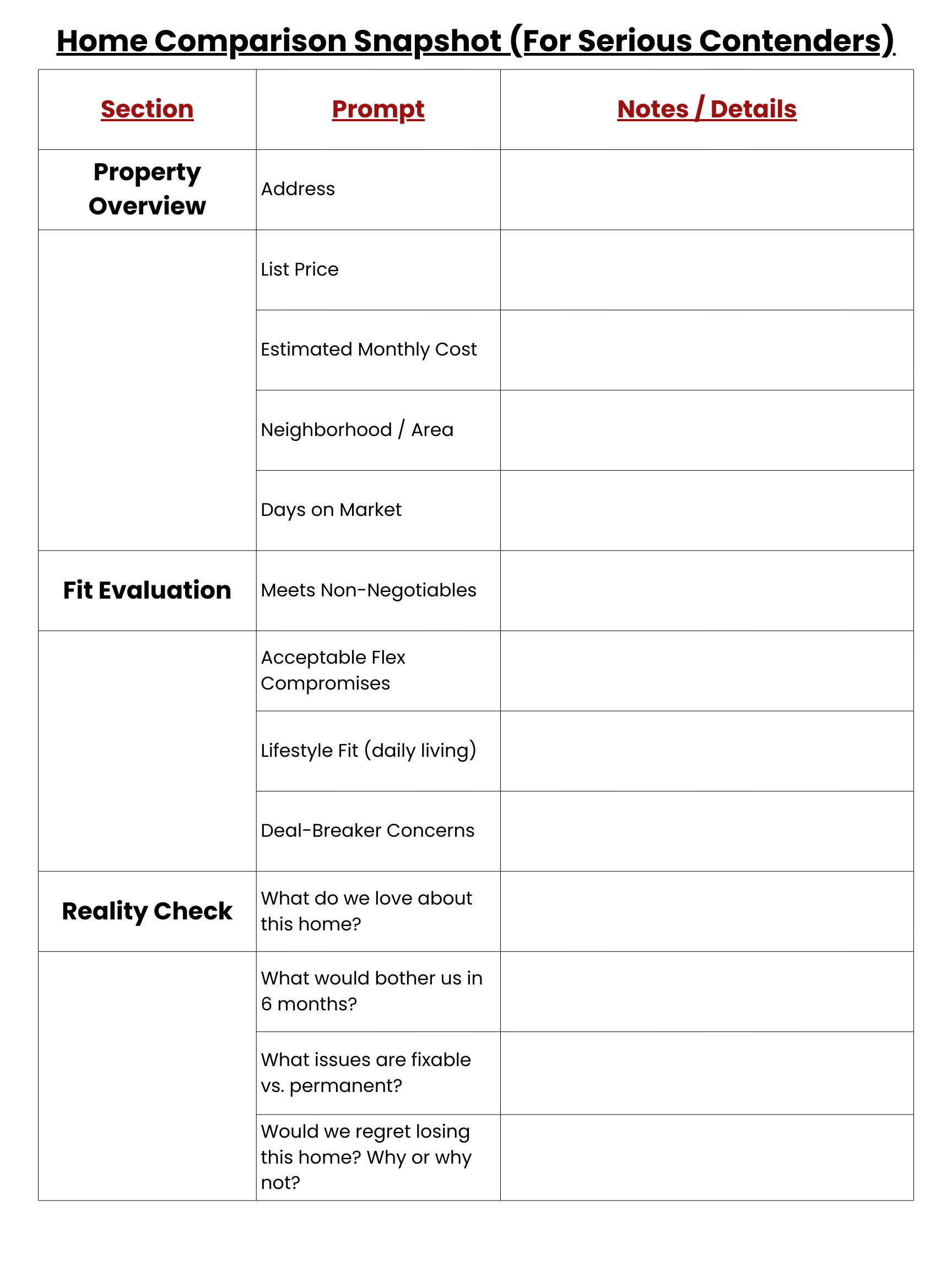
Tool #2: Home Comparison Snapshot—For Serious Contenders
Save deeper analysis for homes that meet most of your non-negotiables and deserve closer consideration. This keeps the process focused without overanalyzing every showing.
4. Pause when emotions begin driving the decision
Excitement, disappointment, and fatigue can all distort judgment. Slowing down when feelings spike helps prevent reactive choices and keeps the search grounded in the framework you built earlier.
Tool #1: House Hunt Tracker
For Back-to-Back Showings
When you are touring several homes in a short window—especially during an out-of-state trip, relocation visit, or packed weekend—details can blur quickly. Homes begin to overlap, and first impressions fade faster than expected.
The House Hunt Tracker is designed for that exact moment.
Use it during or immediately after each showing to record:
- The basics: price, location, and first impression
- Whether the home fits your non-negotiables
- Whether it deserves a second look
This tool is not meant for deep analysis. It is meant to keep you oriented while the search is moving quickly. It helps you get through a full day of showings without relying on memory alone or letting emotional overload take over.
Think of it as your search log—not your final decision-maker.
Tool #2: Home Comparison Snapshot
For Serious Contenders
Once a few homes begin to stand out, the search shifts. Emotion often intensifies at this stage, and second-guessing can creep in.
The Home Comparison Snapshot is designed for use after the showing, when you are deciding whether a home deserves serious consideration.
Use it for homes that:
- Clearly meet most of your non-negotiables
- Feel like legitimate options
- Could realistically become “the one”
This tool slows the process just enough to help you:
- Separate emotional pull from practical fit
- Distinguish true deal-breakers from fixable concerns
- Compare strong options side by side without pressure
It is not meant for every home you tour—only for the ones that truly merit a closer look.
Frequently Asked Questions About House Hunting
How many homes should buyers tour in one day?
There is no perfect number, but buyers should be careful about scheduling more homes than they can reasonably process. A packed showing day can be helpful in a tight timeline, but it works best when buyers take notes, compare quickly, and leave room to discuss what stood out.
Should buyers look at homes above their budget?
Usually, buyers should be cautious about touring homes above their comfort range. Seeing properties that are not financially realistic can make well-fitting homes feel disappointing and may create pressure to stretch beyond what feels sustainable.
What should buyers pay attention to during a showing?
Buyers should look beyond finishes and focus on layout, natural light, storage, condition, noise, yard usability, parking, location, and how the home supports daily routines. Pretty features matter, but function usually matters more after move-in.
Is it normal for buyer priorities to change during the search?
Yes. Touring homes often helps buyers better understand what matters most. The key is knowing whether a preference is changing because of real-life clarity or because of fatigue, pressure, or fear of missing out.
Should buyers revisit a home before making an offer?
When possible, a second showing can be helpful for serious contenders. Buyers often notice different details once the first emotional reaction has settled, especially around layout, condition, traffic, noise, storage, and overall comfort.
How can buyers compare homes in different neighborhoods?
Buyers should compare more than the house itself. Commute, schools, amenities, taxes, HOA rules, future development, nearby roads, and resale considerations can all affect whether one home is a better fit than another.
What are common signs of house hunting fatigue?
Common signs include forgetting which home had which feature, feeling irritated by every option, rushing to choose just to be done, or dismissing homes without clear reasons. When that happens, it may be time to pause and reset the search strategy.
Should buyers keep looking after finding a home they like?
Sometimes a little comparison can help confirm the decision, but endless searching can create confusion. Once a home fits the buyer’s priorities, budget, and comfort level, the focus should shift from finding something perfect to deciding whether it is the right fit.
What if buyers cannot find a home that checks every box?
Most buyers eventually have to weigh trade-offs. The goal is to separate true needs from preferences and decide which compromises are acceptable. A home does not have to be perfect to be a strong fit.
Continue the Buyer Journey
Previously:
👉
Before You Ever Tour a Home
Next:
As one home begins to stand out, the next stress point is deciding how to move forward. The following post explains how to approach pricing, terms, and offer strategy thoughtfully—without letting pressure take over.
If you are planning to buy a home in Wylie, Little Elm, Fairview, or anywhere across North Texas and the DFW area, Cindy Coggins Realty Group can help you evaluate your options, understand how local market conditions may affect your decisions, and move forward with greater clarity at every stage of the process.
When you are ready, reach out to start the conversation and move forward with confidence.
Message Cindy to receive your complete copy of the Buyer’s Reality Check Series and buy with clarity instead of guesswork.
📞
Call or Text:
(469) 499-7452
📧
Email:
cindycoggins@kw.com
⭐
See why so many clients trust us—check out our 5-star reviews on Google.
Disclaimer:
This series is provided for general educational purposes only and is not intended as legal, financial, tax, lending, inspection, insurance, or real estate advice. Every buyer’s situation is different, and market conditions, loan requirements, contract terms, property conditions, timelines, and transaction decisions can vary. Readers should verify information independently and consult the appropriate professionals, including a real estate agent, lender, inspector, insurance provider, title company, attorney, CPA, and other qualified advisors as needed. Information is deemed reliable but not guaranteed.
Search Post
Recent Post










 Mr. Website Designer