
Writing an Offer Without Regret | The Buyer’s Reality Check Series
Offer Phase

This is often one of the hardest stages for buyers—not because they do not want the home, but because the decision suddenly feels consequential.
Writing an offer compresses several fears into a short window of time: overpaying, losing the home, or making a choice that may not feel right later. Even confident buyers can feel exposed in this moment. That response is normal. What matters is having a way to work through it clearly.
Regret in real estate rarely comes from losing a house. More often, it comes from making a decision that does not align with financial comfort, personal priorities, or long-term stability. The goal of an offer is not simply to win. It is to make a choice your future self can live with.
Why This Step Feels So Heavy
By the time you are writing an offer, you have already invested time, attention, and emotion. The home feels familiar. Other options feel less certain. That attachment can quietly begin to compete with clear thinking.
This is also when outside noise tends to get louder—stories about bidding wars, advice from friends, market headlines, and the fear that another opportunity may not come along. Under pressure, the brain often looks for relief, not clarity. Buyers may respond by stretching beyond their comfort level or freezing altogether. Neither creates confidence.
Price vs. Impact
When writing an offer, many buyers focus first on price. But what matters just as much is impact.
Price is the number written into the contract.
Impact is how that decision affects life after closing—your monthly payment, remaining cash reserves, lifestyle flexibility, and overall stress level.
Price influences long-term equity.
Impact shapes day-to-day life.
Before finalizing an offer, revisit the monthly comfort range you defined earlier. If the payment stretches beyond what felt sustainable before emotions were involved, it may feel even heavier later—after closing costs, maintenance, utilities, and everyday life settle in.
Protecting your future self means honoring the boundaries you set when the pressure was lower and your thinking was clearer.
Use Structure to Stay Grounded
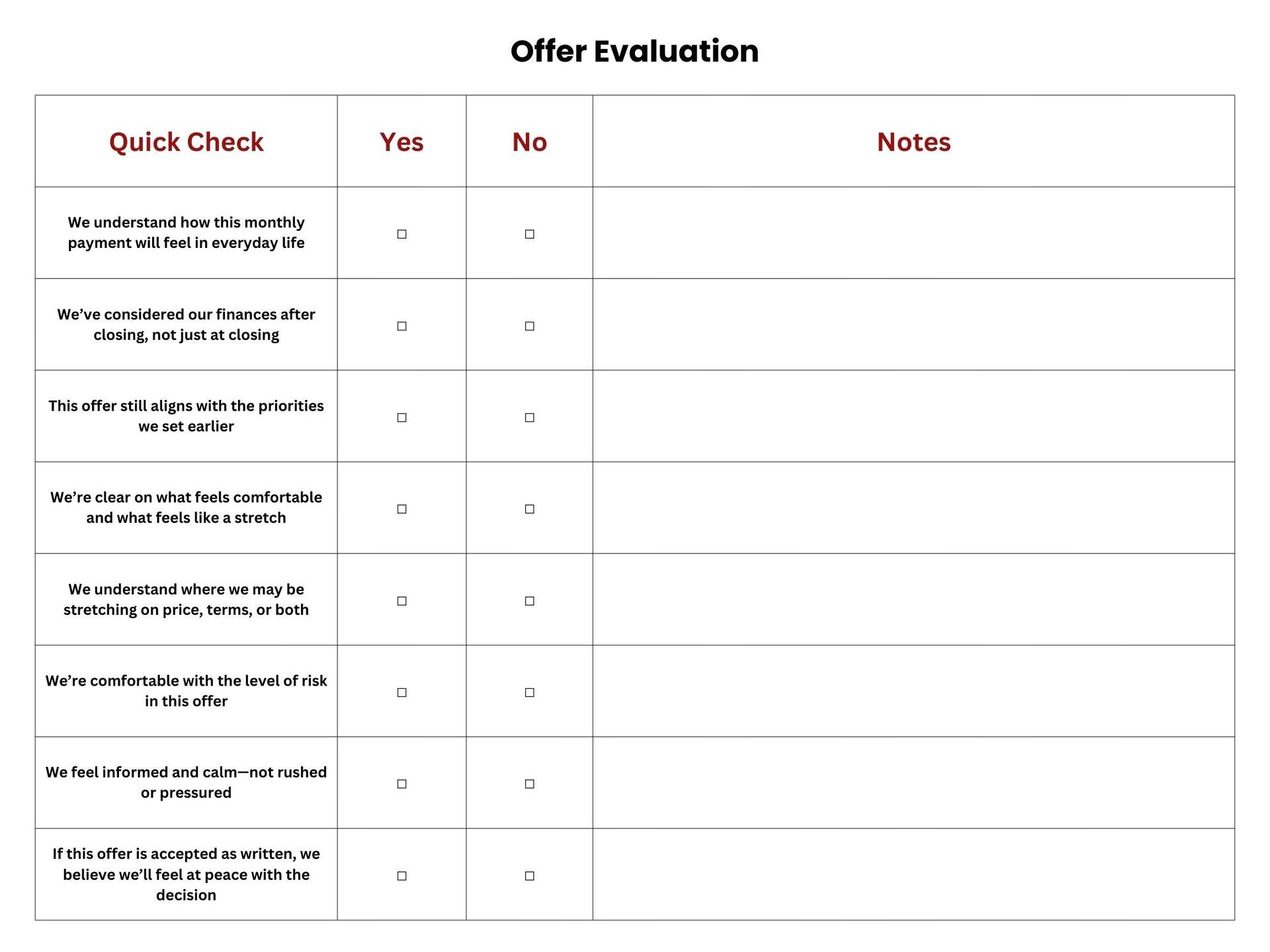
At this stage, structure is not meant to slow the process down. It is meant to protect the decision.
Rather than reanalyzing everything from the beginning, use the Offer Alignment Check to confirm that the offer still fits the life you planned for—not just the urgency of the moment. This tool is designed to uncover pressure, clarify trade-offs, and help ensure the decision feels intentional.
If most of your answers feel steady and confident, that suggests alignment.
If several give you pause, that is useful information—not failure.
The Sleep Test
The Offer Alignment Check ultimately leads to one simple question:
If this offer is accepted exactly as written, will I sleep well tonight?
If the answer is no, pause. Revisit the price, terms, or expectations until the decision feels steadier. This is not about letting fear take over. It is about making an offer you are less likely to second-guess later.
Offers made from clarity tend to hold up, regardless of the outcome. Offers made from panic often do not.
Winning Isn’t the Same as Overextending
A successful offer is not simply one that gets accepted. It is one that still makes sense after the excitement passes.
A well-aligned offer:
- Fits your financial comfort without pushing your monthly payment, cash reserves, or post-closing plans beyond what feels sustainable
- Respects your priorities instead of asking you to ignore deal-breakers just to stay in the running
- Reflects the property’s value and condition as clearly as possible with the information available at the time
- Leaves room for life after closing—maintenance, furniture, repairs, savings goals, and the unexpected costs of ownership
- Feels intentional, not reactive—a choice made from clarity rather than competition, fear, or outside pressure
Sometimes the right outcome is moving forward with confidence. Sometimes it is walking away knowing you stayed true to the framework you built before the pressure set in.
Both outcomes protect your future self.
Frequently Asked Questions About Writing an Offer
What should buyers review before making an offer?
Buyers should review the list price, recent comparable sales, property condition, days on market, seller disclosures, estimated monthly payment, closing costs, and any terms that may affect the strength or comfort of the offer.
Is the highest offer always the strongest offer?
Not always. Sellers may also consider financing type, closing timeline, option period length, earnest money, appraisal terms, leaseback needs, and the overall certainty of the offer. Price matters, but terms can matter too.
How much earnest money should a buyer offer?
Earnest money is negotiated and can vary by market, price point, and offer strategy. Buyers should understand how much they are putting at risk, when it is due, and what contract terms may affect whether it is refundable.
Can buyers ask the seller to pay closing costs?
Sometimes. Seller-paid closing costs may be negotiated as part of the offer, but they can affect how the seller views the net proceeds. Loan type, lender limits, and market conditions may also influence what is possible.
What contingencies should buyers understand before submitting an offer?
Buyers should understand any protections related to financing, appraisal, inspection, title, HOA documents, sale of another property, or other contract terms. The strength and risk of an offer often depend on these details.
Should buyers include a deadline for the seller to respond?
A response deadline can help create clarity, but the timing should be chosen carefully. Too short of a deadline may pressure the seller unnecessarily, while too long of a deadline may leave the buyer waiting without direction.
Can a buyer change an offer after submitting it?
An offer may sometimes be revised before it is accepted, but timing matters. Once both parties agree in writing and the contract is executed, changes typically require written agreement from both sides.
What happens if there are multiple offers?
In a multiple-offer situation, the seller may accept one offer, reject offers, counter one offer, or ask buyers to submit their best and final terms. Buyers should decide in advance what they are comfortable offering rather than reacting only to competition.
How can buyers avoid overcommitting in an offer?
Buyers can protect themselves by reviewing the full cost of the offer, understanding the deadlines and deposits involved, and making sure the terms still fit their needs if the offer is accepted exactly as written.
Continue the Buyer Journey
Previously:
👉
House Hunting Without Burnout
Next:
Once an offer is accepted, the process enters a new phase—inspections, deadlines, repair decisions, and the work of confirming whether the home still makes sense after a closer look.
Making Informed Buying
Decisions Across North Texas & DFW
If you are planning to buy a home in Carrollton, Addison, Richardson, or anywhere across North Texas and the DFW area, Cindy Coggins Realty Group can help you evaluate your options, understand how local market conditions may affect your decisions, and move forward with greater clarity at every stage of the process.
When you are ready, reach out to start the conversation and move forward with confidence.
Message Cindy to receive your complete copy of the Buyer’s Reality Check Series and buy with clarity instead of guesswork.
📞
Call or Text:
(469) 499-7452
📧
Email:
cindycoggins@kw.com
⭐
See why so many clients trust us—check out our 5-star reviews on Google.
Disclaimer:
This series is provided for general educational purposes only and is not intended as legal, financial, tax, lending, inspection, insurance, or real estate advice. Every buyer’s situation is different, and market conditions, loan requirements, contract terms, property conditions, timelines, and transaction decisions can vary. Readers should verify information independently and consult the appropriate professionals, including a real estate agent, lender, inspector, insurance provider, title company, attorney, CPA, and other qualified advisors as needed. Information is deemed reliable but not guaranteed.
Search Post
Recent Post









 Mr. Website Designer