
After the Sale
What to Keep, Close Out, and Stop Worrying About After Closing

Closing day feels final.
The keys are gone. The proceeds have been disbursed. The buyer owns the house. You may already be living somewhere else and thinking more about unpacking boxes than about the property you just sold.
That is exactly where you should be.
But before the old house completely disappears from your day to day life, there are a few things worth wrapping up.
Not because you should expect a problem.
Because some parts of a home sale outlive closing day: records, refunds, tax documents, old accounts, and occasionally one loose end nobody notices until weeks later.
Handle those.
Then let the sale be finished.
Keep the Records That Would Be Hard to Recreate Later
You do not need to save every email thread or every showing notification from the past six months.
You should keep the documents that explain what actually happened.
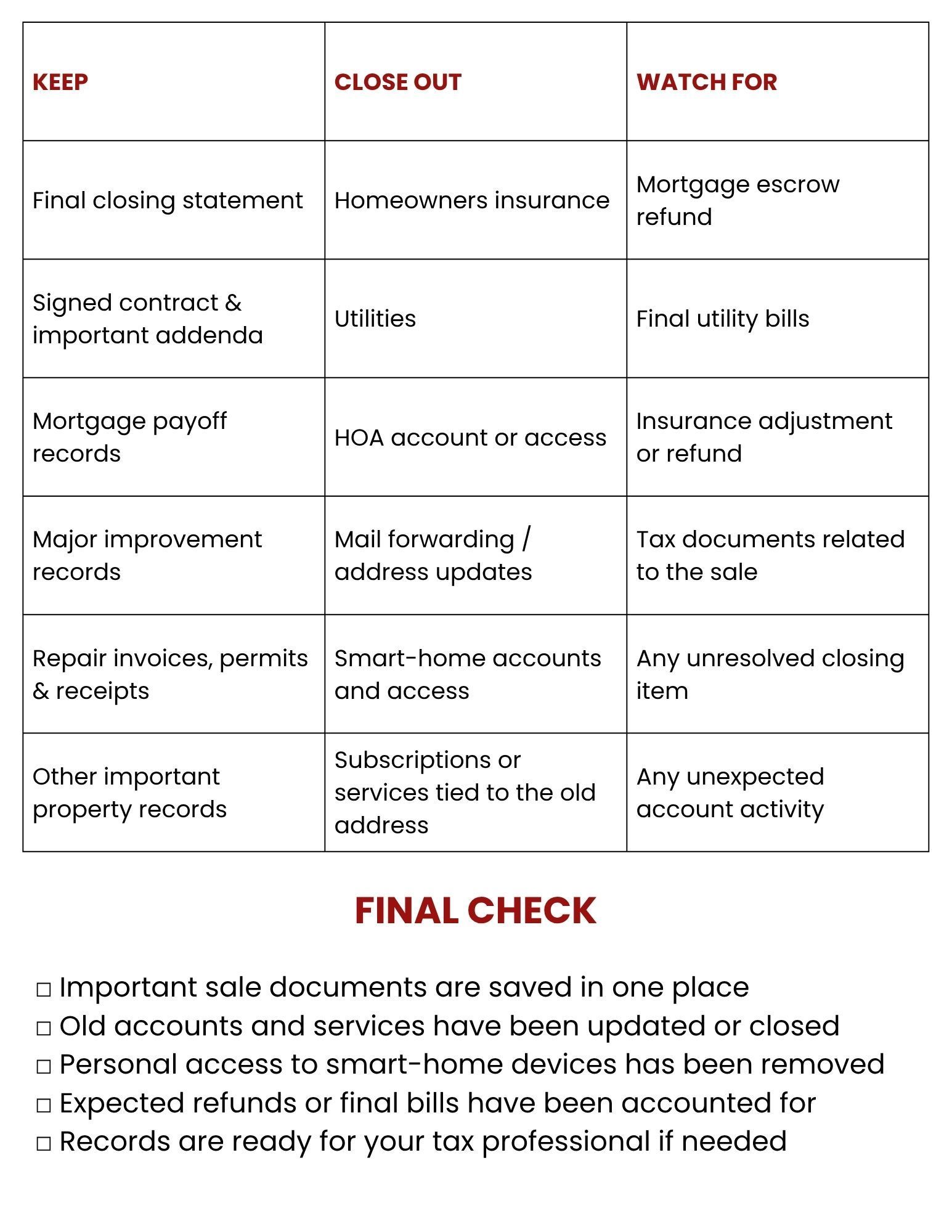
That generally means your final closing statement, signed contract and important addenda, mortgage payoff information, and records tied to meaningful improvements or expenses associated with the property. If repairs, permits, invoices, or other documentation became important during the transaction, keep those with the file too.
Why?
Because memory is a terrible filing system.
A tax professional may ask about the sale later. You may need to verify what you spent improving the property. A question may come up about a payoff, a closing charge, or something that was handled during the transaction.
You do not want to reconstruct years of ownership from old bank statements and faded receipts if you can avoid it.
Create one digital folder with the property address and put the important records there.
Then you can stop thinking about them.
Make Sure the Old House Actually Leaves Your Life
The deed may have transferred immediately.
Every account connected to the house probably did not.
There may still be a mortgage escrow refund, final utility bill, insurance adjustment, HOA item, or other balance that works its way through after closing. Mail forwarding may be in place while subscriptions, financial accounts, online orders, or other records still carry the old address.
Smart-home equipment can create another overlooked connection. A thermostat, camera, doorbell, lock, garage system, or security device may stay with the property while the seller’s personal account does not.
Those two things should not be confused.
The easiest approach is to pay attention for a short period after the sale. Watch for refunds you are expecting, bills that still belong to you, and accounts that should no longer be connected to the property.
This is not a new phase of the transaction.
It is cleanup.
And once it is handled, it should stay handled.
Keep the Sale in Mind When Tax Season Arrives
One mistake I would avoid is assuming the tax side of the sale is automatically simple because it was your primary residence.
Sometimes it is.
Sometimes there is more to consider.
How long you owned the property, how you used it, your gain, certain improvements, selling expenses, and your individual circumstances can all matter.
That does not mean every seller owes capital gains tax.
It also does not mean every seller should decide for themselves that nothing applies.
This is where those records you saved become useful.
Your original purchase information, major improvement records, final closing statement, and other sale-related documents may help a tax professional determine basis, gain, and what is actually relevant to your situation.
The real estate agent’s job is not to become your CPA after closing.
My job is to tell you not to throw away the paperwork your CPA may eventually ask for.
Do Not Re-Sell
the House in Your Head
This is the part sellers do not always expect. After the sale, new information starts appearing. Another home in the neighborhood sells for more, rates change, inventory drops, or the new owner paints the kitchen you spent months worrying buyers would dislike. Suddenly, it can be tempting to revisit the entire decision and wonder whether you should have waited, whether you could have gotten more, whether you negotiated too much, or whether you spent money before listing that was not really necessary.
Those questions are easy to ask once the outcome is known, but they are not always fair. You made the sale using the market, competition, offers, timing, finances, and information available to you at the time. A decision does not become a bad one simply because the future unfolded differently than anyone could have known.
That is one of the reasons I believe sellers should have a clear plan before listing. When you understand why you made the decisions you made, you are less likely to rewrite the story later based on information you never had. Could there always have been another path? Of course. That does not mean it would have been the better one.
The Bottom Line
Selling a home is a series of decisions made before you know exactly how every part will turn out. You decide what is worth fixing and what is not, where to price, how buyers are actually responding, whether an offer is as strong as it first appears, and how to work through inspection, appraisal, financing, and closing. Sometimes the right move is obvious. Often, it is not.
That has been the point of this entire series. Not to make every seller an expert in contracts, inspections, lending, appraisal, taxes, or market statistics, but to help you recognize which decisions deserve more thought and which ones do not need to take over the entire sale.
Once the records are saved, the accounts are closed out, and the remaining financial loose ends are handled, there is no benefit in continuing to manage a house you no longer own. The sale is over. Whatever comes next gets to be the focus.
If there is one idea I hope sellers take from the entire series, it is this:
You do not have to make every decision perfectly.
You do need to know what problem you are trying to solve.
Sometimes that means preparing more.
Sometimes it means spending less.
Sometimes it means adjusting the price.
Sometimes it means waiting.
Sometimes it means negotiating.
And sometimes the most valuable thing I can tell a seller is:
I would not do that.
If you are considering selling in
Allen,
McKinney,
Frisco,
Plano,
Melissa, or elsewhere in
North Texas, we would be glad to help you think through the decisions before they become expensive ones.
👈
Previously:
Closing Week Without the Scramble
Start at the beginning:
Selling a Home, Clearly | The Seller’s Reality Check Series
Message Cindy to receive your complete copy of the Seller’s Reality Check Series and sell with clarity instead of guesswork.
📞
Call or Text:
(469) 499-7452
📧
Email:
cindycoggins@kw.com
⭐
See why so many clients trust us—check out our 5-star reviews on Google.
Disclaimer:
This series is provided for general educational purposes only and is not intended as legal, financial, tax, lending, inspection, insurance, appraisal, title, accounting, or real estate advice. Every seller’s situation is different, and market conditions, property condition, contract terms, financing, appraisal results, closing costs, tax consequences, timelines, and transaction decisions can vary. Readers should verify information independently and consult the appropriate professionals, including a real estate agent, lender, inspector, insurance provider, appraiser, title company, attorney, CPA, tax professional, and other qualified advisors as needed. Information is deemed reliable but not guaranteed.
Search Post
Recent Post











 Mr. Website Designer