
Closing Week Without the Scramble
What Sellers Need to Handle Before the Sale Is Actually Finished

By closing week, most sellers are ready to be done.
The inspections are behind you. The appraisal is finished. Financing may be nearly complete. Boxes are everywhere, movers are scheduled, and everyone is talking about closing as though the sale has already happened.
It has not.
Closing week is usually not about making another major decision. It is about making sure everything already agreed to actually gets carried through correctly.
This is where small details can become surprisingly inconvenient if they are overlooked. A repair was completed but the receipt cannot be found. A garage remote disappeared into a moving box. Utilities were scheduled to shut off too early. An item the buyer expected to stay left with the movers.
None of those things should derail a good transaction, but why create a last-minute problem when it could have been handled two days earlier?
The goal is not to make closing week stressful.
It is to make it boring.
Finish the House
Before You Finish the Move
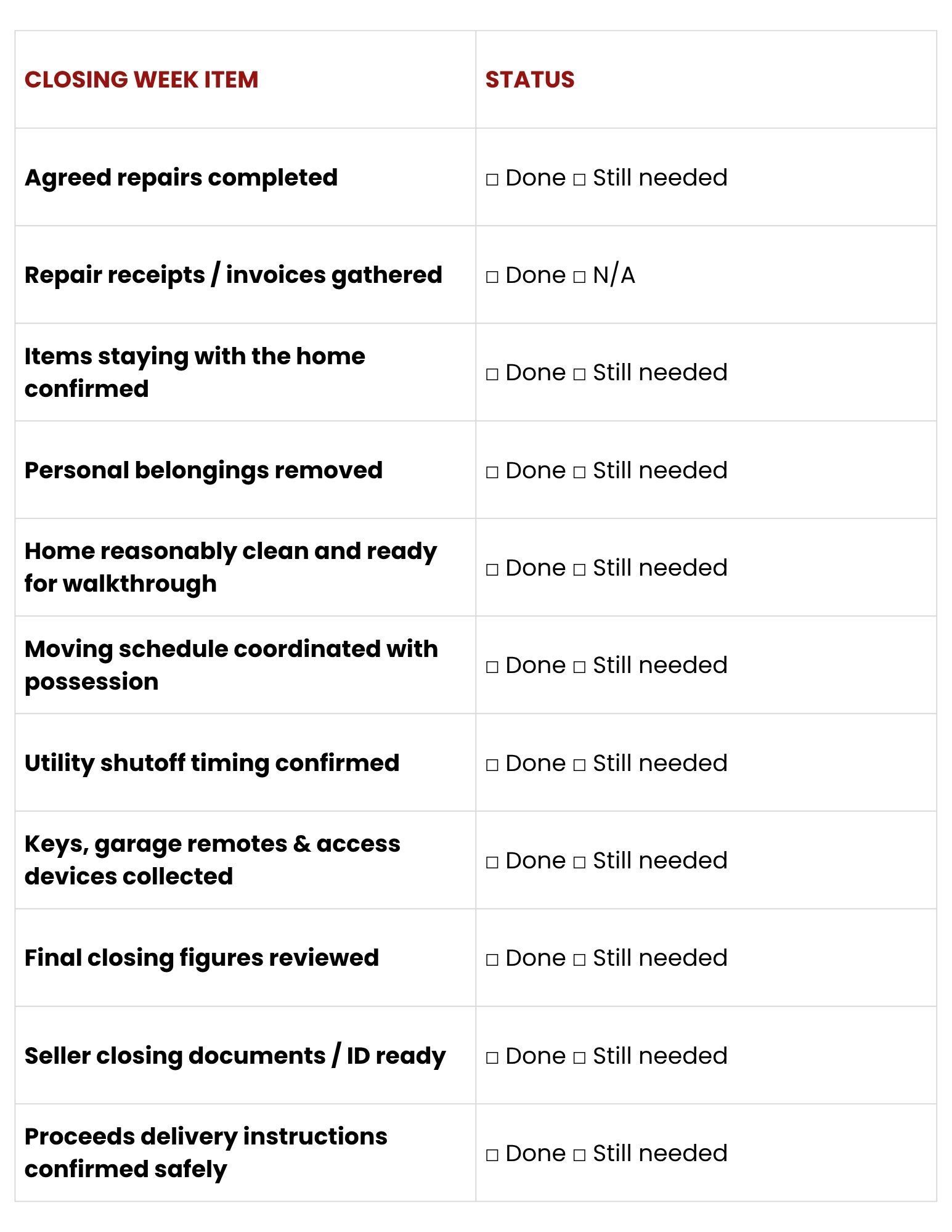
The first priority is making sure the property itself is ready for the handoff.
Any repairs the seller agreed to should be completed according to the agreement, with receipts, invoices, permits or other documentation available when needed. If the buyer is expecting work by a particular type of professional, closing week is not the time to discover that the repair was handled differently.
The same applies to the condition of the home.
The buyer’s final walkthrough is generally not another inspection or an opportunity to start the transaction over. It is a chance to make sure the property is still in the expected condition, agreed repairs are complete, and items that were supposed to remain are still there.
That sounds simple until moving begins.
What happens if a mover damages a wall? A plumbing leak appears? A fixture disappears because the seller thought it was personal property? The refrigerator that was supposed to stay is suddenly on the truck?
The safest approach is not to rely on memory. Before the house is emptied, verify what stays, what goes and what still needs to be completed.
The buyer contracted for a particular property in a particular condition. Closing week is about delivering that property.
Coordinate the Move With Possession, Not Just Closing
Sellers often think of the closing date as the moment everything changes.
Sometimes it is. Sometimes it is not.
What matters is the possession arrangement in the contract.
If the buyer receives possession at closing and funding, the seller needs to be out according to that agreement. If there is a temporary seller leaseback or another arrangement, the timeline may be different.
This is why I would not schedule a move based only on the words “closing day.”
Know when the buyer actually gets the property.
That timing also affects keys, garage remotes, gate access, mailbox keys, security systems, smart-home equipment and utilities. Sellers sometimes schedule electricity or water to shut off first thing on closing day because they assume their responsibility ends that morning.
But what if closing is delayed a few hours? What if the buyer still needs utilities operating for the walkthrough? What if possession transfers later?
The cleaner approach is to coordinate moving and utility timing with the actual possession plan.
And while you are packing, pay attention to the less obvious items. Curtain rods, wall-mounted equipment, television mounts, shelving, security devices and outdoor fixtures can create confusion because sellers may think of them differently than the contract does.
If something is attached to the property or specifically addressed in the agreement, verify before it leaves.
Review the
Numbers Before You Sign
By closing week, sellers have seen enough documents to last them a while.
Still, the final numbers deserve attention.
The seller should understand the sale price, mortgage payoff, commissions, taxes, credits, concessions, title-related charges and other expenses affecting the final proceeds.
The number at the bottom matters, but so does understanding how it got there.
If something is different from what you expected, ask about it before signing. A changed number is not automatically a problem. Payoffs, prorations and other figures can move as the closing date approaches.
But you should not be sitting at the closing table wondering why your expected proceeds suddenly look different.
This is also the time to confirm how sale proceeds will be delivered and what the title company requires from you.
Wire fraud is a very real concern around real estate closings, so sellers should be extremely cautious with emails that suddenly change wiring instructions or payment information. If something changes, verify it through a trusted contact method you already have rather than relying on information inside the new message.
Leave the Property
Ready for the Buyer
There is a difference between being moved out and being finished.
Personal belongings should be removed unless otherwise agreed. Trash should be gone. The property should be reasonably clean. Keys, garage remotes and access devices should be gathered rather than left scattered through drawers or accidentally packed into a box.
This does not mean the house has to look staged again.
It means the handoff should feel complete.
If you were the buyer walking into the property for the first time after closing, what would you reasonably expect to find?
That is a pretty good standard.
Closing week is already busy. Spending twenty minutes collecting mailbox keys, gate remotes, garage openers and access information before the movers leave is much easier than trying to locate them after the sale has closed.
Do Not Mentally Close Before the Transaction Actually Closes
Once the buyer has made it through financing and everyone has a closing appointment, it is easy to start treating the house as sold.
Usually, everything is moving exactly where it should.
But the seller still owns the property until the transaction reaches the actual closing and funding point required for the sale.
So keep the house insured. Keep it maintained. Stay reachable. Complete the agreed obligations. Do not make a major change to the property because “we close Friday anyway.”
There is no need to spend closing week expecting something to go wrong.
There is also no benefit in creating a problem because everyone mentally finished the transaction three days early.
The Bottom Line
The smoothest closing weeks usually have very little left to figure out.
Repairs are finished. The seller knows when to move. Everyone understands possession. The closing numbers have been reviewed. Utilities are coordinated. The correct items are staying with the house. Keys and access devices are ready.
None of that is dramatic.
That is exactly what we want.
The best closing week is usually the one where everything important was handled before it became urgent.
Next in the Seller’s Reality Check Series:
👉 After the Sale (release date: 10/21/26)
👈 Previously: Appraisal, Financing & the Waiting Game
Start at the beginning:
Selling a Home, Clearly | The Seller’s Reality Check Series
Closing may finish the transaction, but there can still be a few loose ends afterward.
In the final article in this series, we will look at what sellers should keep, what may still arrive after closing, and what deserves attention once the keys have officially changed hands.
Message Cindy to receive your complete copy of the Seller’s Reality Check Series and sell with clarity instead of guesswork.
📞
Call or Text:
(469) 499-7452
📧
Email:
cindycoggins@kw.com
⭐
See why so many clients trust us—check out our 5-star reviews on Google.
Disclaimer:
This series is provided for general educational purposes only and is not intended as legal, financial, tax, lending, inspection, insurance, appraisal, title, accounting, or real estate advice. Every seller’s situation is different, and market conditions, property condition, contract terms, financing, appraisal results, closing costs, tax consequences, timelines, and transaction decisions can vary. Readers should verify information independently and consult the appropriate professionals, including a real estate agent, lender, inspector, insurance provider, appraiser, title company, attorney, CPA, tax professional, and other qualified advisors as needed. Information is deemed reliable but not guaranteed.
Search Post
Recent Post











 Mr. Website Designer