
Appraisal, Financing & the Waiting Game
What Sellers Need to Know Between Under Contract and Clear to Close

Once the inspection period is behind you, the transaction can feel almost finished.
The buyer is committed. Repairs have been negotiated. The closing date is on the calendar.
But there is an important difference between under contract and ready to close.
This part of the transaction is less visible because much of the work is happening between the buyer, lender, appraiser, insurance company, title company, and other parties. For the seller, that can create an uncomfortable stretch where there is not much to do—but there are still several things that have to go right.
I do not think sellers need to worry through every quiet day.
I do think they should understand what we are waiting on.
The Appraisal Is Testing the Financing, Not Repricing Your House
When the appraisal comes back, sellers can take the number very personally.
If the contract is for $600,000 and the appraisal comes in at $585,000, it can feel as though someone just announced that the house is worth $15,000 less.
That is not the most useful way to look at it.
The buyer and seller already agreed on a price. The appraisal is now helping the lender determine how much value it is willing to support for the loan.
That distinction matters because a buyer may have reasons for paying more than the comparable sales alone suggest. Maybe the lot is unusually important to them. Maybe inventory in that neighborhood is limited. Maybe they competed against another buyer.
The appraiser still has to develop an independent opinion of value.
So when there is a gap, the immediate issue is not:
“Who was wrong about the house?”
It is:
“Does the financing still work at the price we agreed to?”
That keeps the conversation focused on the actual problem.
A Low Appraisal Creates a Decision Point, Not an Automatic Price Change
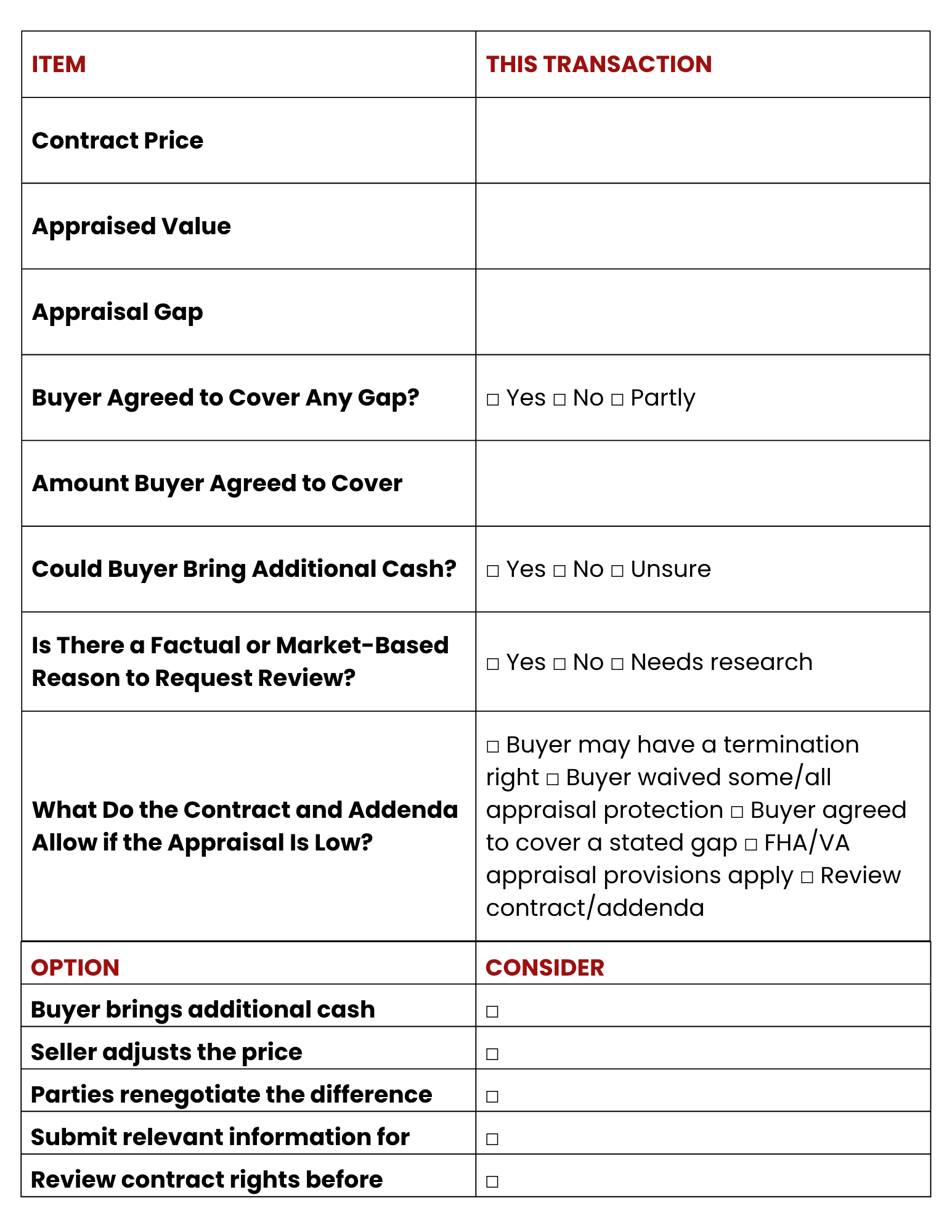
If the appraisal is below the contract price, the seller does not automatically have to reduce the price to match it.
And the buyer does not automatically have to cover the entire difference.
What happens depends on the contract, the buyer's financing, any appraisal-related terms negotiated with the offer, and what the parties are willing and able to do next.
The useful number is the gap.
If the contract price is $600,000 and the appraisal is $590,000, there is a $10,000 difference that now has to be accounted for somehow.
The buyer may have agreed in advance to cover some appraisal shortfall. They may have additional cash available. The parties may renegotiate. There may also be a lender process for reviewing relevant information when there is a legitimate reason to question the appraisal.
The important part is not assuming the outcome before we read the contract and understand the financing.
If You Question the Appraisal, Bring Better Information
A reconsideration of value should be more than:
“We think the house is worth more.”
Useful information is specific.
Maybe the appraisal contains a factual error about the property. Maybe an important feature was recorded incorrectly. Maybe there is a relevant comparable sale that deserves consideration. Maybe the appraiser did not have information about a permitted addition or significant feature.
That is different from arguing that a renovation cost $50,000, so the home must be worth $50,000 more.
What something cost the seller and what the market recognizes in value are not necessarily the same thing.
If there is a reasonable basis for asking that an appraisal be reviewed, the strongest case is built with facts—not frustration.
Financing Has More Than One Moving Part
A buyer can be financially qualified and still have things left to complete before closing.
Their lender is not only evaluating whether the buyer can afford the loan. The lender is also putting together a transaction that includes the buyer, the property, the appraisal, insurance, title related information, and whatever conditions apply to that particular loan.
That is why the financing process can sometimes seem confusing from the seller's side.
A buyer may have been very well qualified when the offer was written and still need to provide updated documents later. The lender may need additional verification. Insurance may reveal an unexpected issue.
Something about the property may need clarification.
None of that automatically means the transaction is in trouble.
What matters is whether each issue has a path to resolution.
A request for one more document is very different from a lender saying the buyer no longer qualifies.
That difference is what I want sellers to understand.
A Closing Date Is Important—but It Is Not Permission to Mentally Close Early
Once the contract is moving smoothly, sellers naturally begin organizing everything around closing day.
Movers get booked.
The next house may be waiting.
Utilities need to be transferred.
Maybe there is a leaseback, temporary housing, or another closing tied to this one.
That planning is necessary.
I would just be cautious about treating the closing as completed before the financing is far enough along to support those commitments.
A few extra days may be a minor inconvenience if you still have flexibility.
The same delay can become expensive if the moving truck is loaded, temporary housing has ended, or another transaction depends on these proceeds arriving that afternoon.
The closer we get to closing, the more confidence we should have about the remaining pieces.
Until then, flexibility has value.
Know What
We Are Waiting On
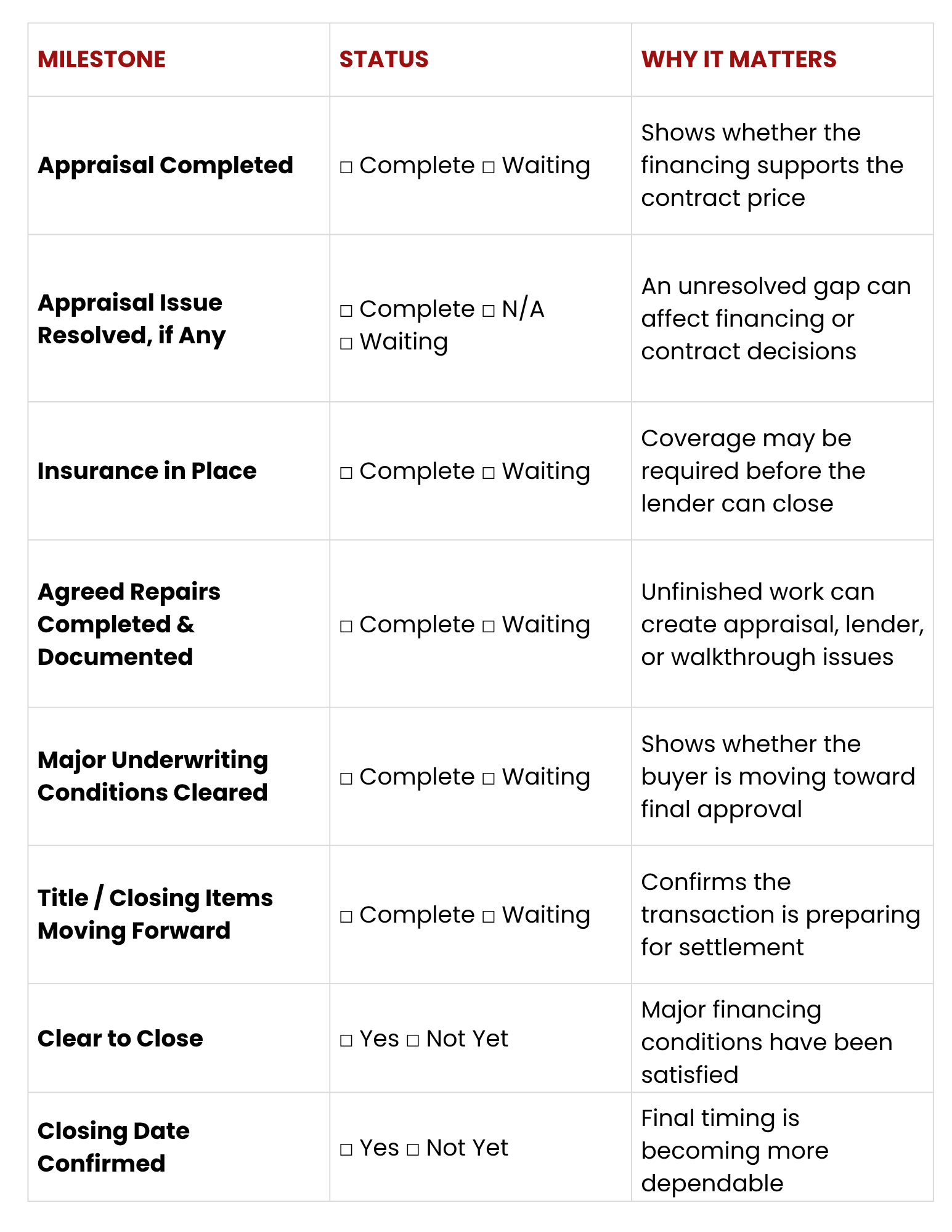
Sellers usually do not need a constant play-by-play from the lender.
What matters more is knowing whether the transaction is moving from one meaningful milestone to the next.
Has the appraisal been completed? If there was a value issue, has it been resolved? Are agreed repairs finished? Is insurance in place? Are significant lender conditions being cleared? Is the file moving toward clear to close?
That tells us much more than simply hearing:
“Everything is still in underwriting.”
The same applies when there is a delay. “Closing is delayed” is not enough information by itself. There is a big difference between waiting on a routine document and dealing with an unresolved appraisal, financing, insurance, title, or property issue.
The important part is identifying what is holding things up and whether there is a clear path to resolve it.
That is what helps us distinguish a normal delay from something that could actually threaten the transaction.
The goal is not to micromanage the buyer’s financing. It is to know whether the transaction is still moving forward—or whether something important has stopped.
The Seller Still Has
a Job Before Closing
Once the home is under contract, it is easy to start mentally treating it as sold.
But the property still has to make it to closing in the condition the buyer agreed to purchase.
That means agreed repairs should be completed and documented, the home should continue to be maintained, and fixtures or other items that are supposed to remain should stay with the property.
If something significant changes before closing—a leak, damage, a system failure, or another material issue—it should be addressed promptly rather than left for the buyer to discover at the final walkthrough.
The buyer did not contract for a different version of the house.
Until closing actually happens, the seller still owns the property and is responsible for getting it to the finish line.
The Bottom Line
This stage is called the waiting game because much of the work is happening somewhere the seller cannot see.
That does not mean the seller needs to worry about every lender request or quiet afternoon.
It means we keep our attention on the things that actually move the transaction forward: the appraisal, financing, insurance, agreed seller obligations, and the remaining path to closing.
Next in the Seller's Reality Check Series:
👉 Closing Week Without the Scramble (release date: 10/20/26)
👈 Previously:
Inspections, Repairs & the Second Negotiation
Start at the beginning:
Selling a Home, Clearly | The Seller’s Reality Check Series
By closing week, the big financial questions should be mostly behind us.
Now the details become very practical: the final walkthrough, repairs and receipts, moving out, utilities, possession, keys, seller documents, and making sure everyone understands exactly when the property changes hands.
That is what we will cover next.
Message Cindy to receive your complete copy of the Seller’s Reality Check Series and sell with clarity instead of guesswork.
📞
Call or Text:
(469) 499-7452
📧?
Email:
cindycoggins@kw.com
⭐
See why so many clients trust us—check out our 5-star reviews on Google.
Disclaimer:
This series is provided for general educational purposes only and is not intended as legal, financial, tax, lending, inspection, insurance, appraisal, title, accounting, or real estate advice. Every seller’s situation is different, and market conditions, property condition, contract terms, financing, appraisal results, closing costs, tax consequences, timelines, and transaction decisions can vary. Readers should verify information independently and consult the appropriate professionals, including a real estate agent, lender, inspector, insurance provider, appraiser, title company, attorney, CPA, tax professional, and other qualified advisors as needed. Information is deemed reliable but not guaranteed.
Search Post
Recent Post











 Mr. Website Designer